

Last updated: 2026-11-06
For an overview of all NIS2 obligations, see NIS2 requirements; for the order in which to proceed, see the NIS2 implementation plan.
Short answer: who does Section 30 BSIG apply to, and what does it require?
Section 30 BSIG applies to essential and important entities. Whether your organisation is one of them, you clarify with the NIS2 applicability check. Under Section 28(5) and (6), Section 30 does not apply to some entities, for example telecoms providers (telecoms providers under NIS2 and the TKG), certain energy companies and financial entities under DORA; the applicability check explains these exemptions and their limits.
It requires three things:
- Take measures that are appropriate, proportionate and effective to avoid disruption to the availability, integrity and confidentiality of your IT and to keep the impact of security incidents low (subsection 1 sentence 1).
- Cover ten areas: “The measures must at least include the following”, says subsection 2 sentence 2 (our translation), followed by points 1 to 10. The measures should comply with the state of the art, take relevant standards into account and must be based on an all-hazards approach (subsection 2 sentence 1).
- Document compliance (subsection 1 sentence 3). Missing measures and missing documentation are each separate administrative offences under Section 65 BSIG.
The obligation has applied since the BSIG entered into force on 6 December 2025 through the NIS2 implementation act, without a general transition period and regardless of whether you have registered yet.
The act measures how much effort is appropriate by the entity’s risk exposure, its size, the cost of implementation and the likelihood, severity and impact of security incidents (subsection 1 sentence 2). For a company with 60 employees, a different level of measures may therefore be appropriate than for a large group. It should, however, be able to explain why its measures fit its risk.
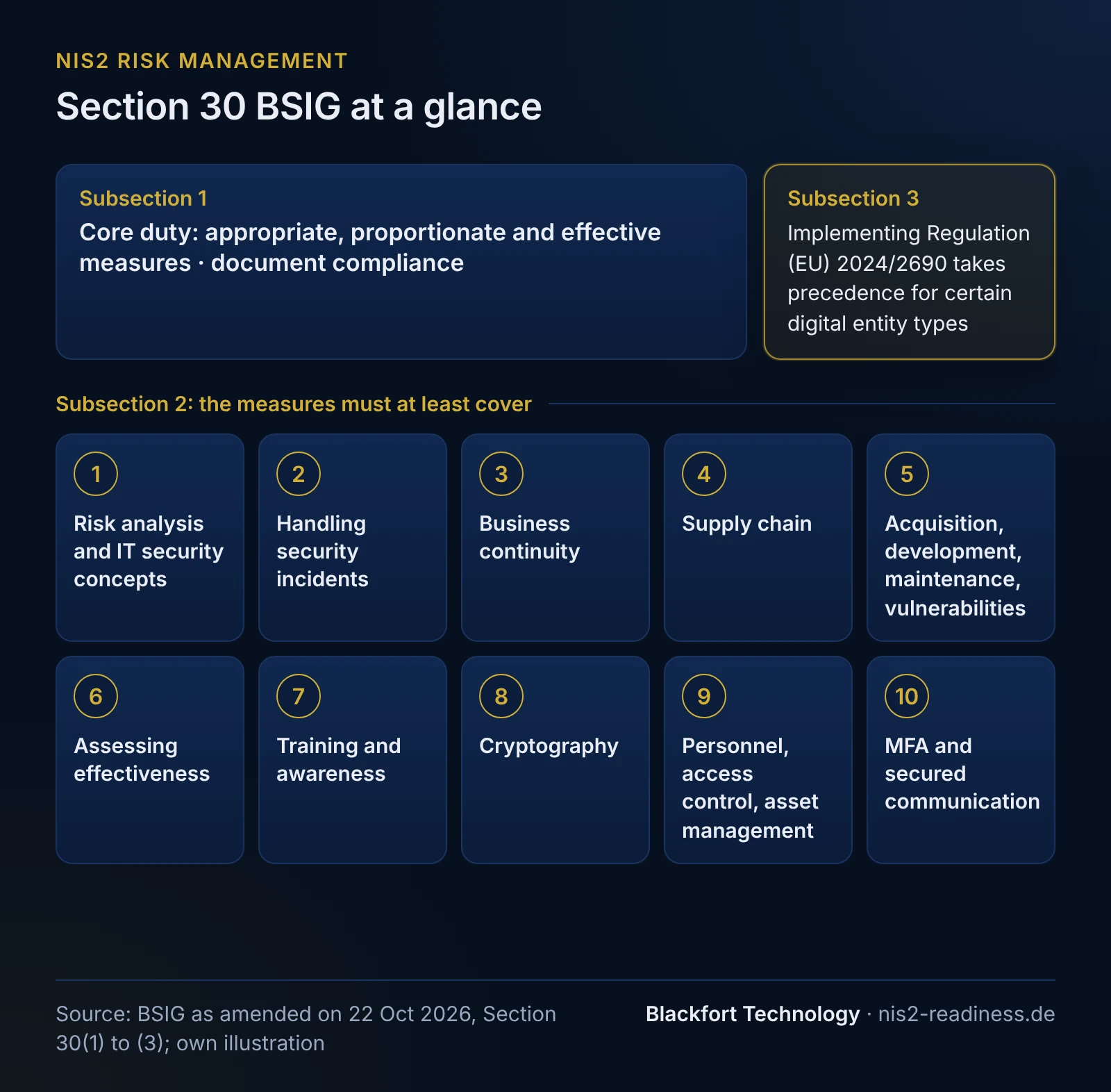
The ten areas with suitable evidence examples
The table separates three levels. Only the wording of Section 30(2) sentence 2 BSIG is a legal obligation; the English text in the table is our translation of the German statute. Section 30 does not prescribe which documents prove implementation. The suitable evidence examples are our professional recommendation; where the BSI, the Federal Office for Information Security, recommends something, this is stated. The Blackfort example shows how a fictitious machinery manufacturer with 180 employees has evidenced each area.
| No. | Legal obligation: wording of Section 30(2) sentence 2 BSIG (our translation) | Suitable evidence examples (professional recommendation) | Blackfort example (fictitious) |
|---|---|---|---|
| 1 | “concepts relating to risk analysis and to information technology security” | documented risk analysis method, risk register with assessment and treatment, security concept approved by management. The method is your choice; the BSI recommends orienting it on, for example, BSI Standard 200-3. More: risk analysis | risk register with 28 risks, treatment plan approved by the managing director |
| 2 | “handling of security incidents” | incident process with roles, reporting chain for the deadlines under Section 32, alerting list that also works outside business hours (the BSI expects this for reporting), record of an exercise. More: incident reporting | incident process in draft, on-call duty arranged, first exercise scheduled |
| 3 | “maintaining operations, such as backup management and recovery after an emergency, and crisis management” | backup concept, record of a restore test, emergency manual, composition and availability of the crisis team. | restore of the ERP database tested and recorded; crisis team still missing |
| 4 | “security of the supply chain, including security-related aspects of the relationships with direct suppliers or service providers” | supplier register with criticality, security clauses in contracts, supplier assessments. The BSI recommends agreements on risk management, incident handling and patch management. More: supply chain | register of 46 IT service providers started, contract clauses missing |
| 5 | “security measures in the acquisition, development and maintenance of information technology systems, components and processes, including management and disclosure of vulnerabilities” | security requirements in procurement, patch and vulnerability process with deadlines by severity, vulnerability scan reports, contact channel for vulnerability reports. | patch policy with deadlines, monthly scan report |
| 6 | “concepts and procedures for assessing the effectiveness of risk management measures in the area of information technology security” | audit plan, records of internal control tests or audits, metrics with target values, report to management. | audit plan in draft, no test yet |
| 7 | “basic training and awareness measures in the area of information technology security” | training plan, attendance records, evaluation of awareness campaigns. Training of the management body is governed separately by Section 38(3). | e-learning with attendance list, phishing exercise evaluated |
| 8 | “concepts and processes for the use of cryptographic procedures” | cryptography concept, overview of the algorithms and keys in use, certificate register with expiry dates. | overview started, cryptography concept missing |
| 9 | “drawing up concepts for personnel security, access control and for the management of ICT systems, products and processes” | authorisation concept, joiner and leaver process, records of access reviews, system inventory. | ERP access review recorded, asset list from the inventory |
| 10 | “use of multi-factor authentication or continuous authentication solutions, secured voice, video and text communication and, where appropriate, secured emergency communication systems within the entity” | MFA coverage report by access type, rules for communication channels, defined fallback channel for emergencies. | MFA for VPN, email and administrator accounts evidenced |
Points 1 to 10 correspond, in the same order, to points (a) to (j) of Article 21(2) of the NIS2 Directive (EU) 2022/2555. The German wording differs in places: point 7 speaks of training and awareness, while the Directive also mentions cyber hygiene; point 9 requires “drawing up concepts”. For your documentation, the BSIG wording is what counts.
Section 30 BSIG checklist in Excel
The checklist maps the ten areas and the documentation duty onto a table. For each area you enter the person responsible, status, evidence and the date of the latest evidence. A second sheet shows the same table filled in for the fictitious example company.
Version 1.1 of 6 November 2026, legal status: BSIG as amended on 22 October 2026. Download: German-language checklist (Excel). The file is in German; its sheets and columns are explained in English below.
You may use and adapt this template within your own organisation. Publication or resale is not permitted.
Contents of the file:
- Deckblatt (cover sheet): version, date, legal status, instructions in five steps, a note that the checklist is not legal advice, terms of use.
- Checkliste (checklist): columns for number, area, short wording, status (drop-down: offen = open, in Arbeit = in progress, umgesetzt = implemented, geprüft (wirksam) = verified (effective)), person responsible, evidence, location, date.
- Beispiel (example): completed version, marked as fictitious.
Preview of the “Beispiel” sheet (extract, fictitious company, translated):
| No. | Area | Status | Responsible | Evidence | Date |
|---|---|---|---|---|---|
| 1 | Risk analysis and security concepts | implemented | information security (internal) | risk analysis method v1.0; risk register with 28 risks; treatment plan approved by the managing director | 14 Oct 2026 |
| 2 | Handling security incidents | in progress | head of IT | incident process v0.9 with reporting chain 24 h / 72 h / 1 month; alerting list with on-call duty | 28 Oct 2026 |
| 4 | Supply chain security | open | purchasing | supplier register started; contract clauses on incident reporting and patch management missing | - |
| 6 | Assessing effectiveness | open | information security (internal) | audit plan 2027 in draft; no control tests yet | - |
| 10 | MFA and secured communication | implemented | head of IT | MFA coverage report: VPN, email and administrator accounts with MFA; fallback channel defined | 31 Oct 2026 |
| D | Documentation of compliance | in progress | information security (internal) | evidence register in the checklist; filed in the document management system | 3 Nov 2026 |
How to use the checklist: First enter a responsible person for each area. Then list the existing documents for each area with title, version and storage location. Where nothing exists, the status stays “open”. Present the list to the management body at least quarterly: under Section 38(1) BSIG it must oversee implementation, and the updated list shows that it does. More on this on the page on management duties.
The checklist is a working aid. It does not replace a risk analysis, and a fully completed list does not by itself prove that the measures are appropriate and effective.
Example: a machinery manufacturer works through the ten areas
Fictitious example, not a client. A machinery manufacturer with 180 employees, its own production IT, an ERP system and an IT department of three people is classified as an important entity (Annex 2, machinery). In autumn 2026, the managing director has the checklist used to check what exists for each area.
Result: three areas are evidenced (1, 7, 10), five are in progress (2, 3, 5, 9 and documentation), three are open (4, 6, 8). IT had implemented a lot but written little down. The managing director decides to add the open areas, with owners and dates, to the implementation plan, starting with the supply chain because contracts with long terms are affected there.
Typical gaps under Section 30 BSIG
| Gap | Cause | Effect | Remedy |
|---|---|---|---|
| Measures implemented but not documented | IT works from experience; documentation is treated as a side issue. | Compliance cannot be demonstrated; missing documentation is a separate administrative offence. | Name and file evidence for each area, keep the checklist as a register. |
| ISO 27001 certificate treated as compliance | The ISMS scope covers only one site or part of the business. | Section 30 applies to the entire entity; the BSI points out that a certificate does not automatically meet all BSIG obligations. | Compare the scope with the whole entity and close the gaps, see NIS2 and ISO 27001. |
| Effectiveness never checked (point 6) | Measures were introduced, but no audit plan was set up. | The act requires effective measures; without tests, effectiveness remains an assertion. | Audit plan with annual control tests and metrics, results reported to management. |
Who is subject to different rules?
Digital entity types: For eleven digital entity types, such as cloud providers, data centres and managed service providers, Implementing Regulation (EU) 2024/2690 takes precedence (Section 30(3)); the sector directory lists them. Its annex sets out the ten areas in 13 chapters and in much more detail, for example an at least annual review of the security policy by the management bodies. An entity that does not apply a requirement which applies there “where appropriate” must document its reasons in a comprehensible way.
Operators of critical facilities: For them, measures beyond the protection level of essential entities are also considered proportionate, and they must use attack detection systems (Section 31 BSIG). They provide evidence every three years under Section 39 BSIG.
All other entities only provide evidence of implementation if the BSI orders it. The documentation should nevertheless be available at all times, because Section 30 requires it regardless of any audit.
Does Section 30 prescribe a standard?
No. The risk analysis method is your choice, and according to the BSI, its IT-Grundschutz methodology is not mandatory for everyone. According to the BSI, a comprehensively implemented ISO 27001 regularly covers a large part of the measures under Section 30, yet it does not automatically fulfil all obligations: registration, reporting deadlines, management responsibility and management training are not part of the standard. How IT-Grundschutz and NIS2 fit together is explained at Grundschutz-Readiness: NIS2 and IT-Grundschutz (in German).
There is no “NIS2 certification”. Certificates under ISO 27001 or IT-Grundschutz can make evidence easier, but they have to be checked against the ten areas and supplemented where necessary.
This page provides general information and is not legal advice. Whether and to what extent Section 30 BSIG applies to your entity has to be assessed in the individual case.
Frequently asked questions
Do all ten areas have to be implemented?+
How does this differ from Article 21 of the NIS2 Directive?+
What evidence does the BSI expect?+
Is the completed checklist enough as evidence?+
Who in the organisation is responsible for Section 30?+
Read more
- NIS2 risk analysis: requirements, method and example
- NIS2 supply chain security: assessing service providers
- NIS2 implementation plan: steps, sequence and a sample plan
- NIS2 requirements in Germany: BSIG obligations matrix
- NIS2 and ISO 27001 in Germany: mapping, differences, gaps
- NIS2 gap analysis in three tiers: indication, gap, roadmap
Sources
- BSI Act (BSIG) Section 30: risk management measures, as amended on 22 October 2026 (German) (retrieved 2026-11-06)
- BSI Act (BSIG) Section 31: special requirements for operators of critical facilities (German) (retrieved 2026-11-06)
- BSI Act (BSIG) Section 38: duties of the management body (German) (retrieved 2026-11-06)
- BSI Act (BSIG) Section 65: fines (German) (retrieved 2026-11-06)
- Directive (EU) 2022/2555 (NIS2 Directive), Article 21 (retrieved 2026-11-06)
- Implementing Regulation (EU) 2024/2690 (retrieved 2026-11-06)
- BSI: general NIS‑2 FAQ (German) (retrieved 2026-11-06)
- BSI: NIS‑2 info package on risk analysis (German) (retrieved 2026-11-06)
- BSI: info package on supply chain security (German) (retrieved 2026-11-06)
- BSI: one-pager NIS‑2 and ISO 27001, version 1.0 (German) (retrieved 2026-11-06)
This content provides general technical and organisational information and does not constitute legal advice (no legal services within the meaning of the German RDG).