

Last updated: 2026-11-06
This page sets out the legal position in Germany: which act transposes NIS2, which version applies, what Section 66 of the BSI Act defers and which ordinances are still pending. Which obligations apply in detail is set out in the overview of NIS2 requirements; whether your company is covered is explained under NIS2 applicability. All statutory texts cited here are German; English terms are our working translations.
What is the German NIS2 implementation act called?
Its official title is “Gesetz zur Umsetzung der NIS‑2-Richtlinie und zur Regelung wesentlicher Grundzüge des Informationssicherheitsmanagements in der Bundesverwaltung”, roughly “Act implementing the NIS2 Directive and regulating essential principles of information security management in the federal administration”. It is dated 2 December 2025 and was published in the Federal Law Gazette (BGBl.) 2025 I No. 301. The BSI, Germany's Federal Office for Information Security, calls it the “NIS‑2-Umsetzungsgesetz”.
You may come across the abbreviation NIS2UmsuCG in articles and searches. It does not appear in the Federal Law Gazette or in the statutory text. “NIS2-Gesetz” (NIS2 Act) is not an official name either. People who use these terms mean the implementation act and above all the BSI Act contained in it. When you cite the law in policies, contracts or reports, refer to the act that contains the obligations: “BSIG as amended on …”.
How is the act structured?
The implementation act is an omnibus act with 30 articles. Article 1 contains the new BSI Act. It replaces the BSI Act of 2009, which Article 29 repealed on the day after promulgation. The other articles amend other laws and ordinances.
| Article | Content | What it means for companies |
|---|---|---|
| Art. 1 | BSI Act (BSIG) | all obligations of essential and important entities: Part 3, Chapters 1 and 2 (Sections 28 to 42), supervision in Part 7, fines in Part 8 |
| Art. 2 to 28 | amendments to other legislation, among them the BSI Critical Infrastructure Ordinance (Art. 8), the Energy Industry Act (Art. 17), Social Code Book V (Art. 21), the Telecommunications Act (Art. 25) and the Trust Services Act (Art. 28) | consequential amendments, among others for energy and telecommunications |
| Art. 29 | repeal of the BSIG 2009 | the old legal basis no longer applies |
| Art. 30 | entry into force on the day after promulgation | effective date 6 Dec 2025 |
For companies, Article 1 is almost all that matters. Part 3 of the BSIG contains classification (Section 28), risk management (Section 30), incident reporting (Section 32), registration (Sections 33 and 34) and management body duties (Section 38). Under Section 28(5), parts of these rules do not apply to certain telecommunications and energy companies; the exceptions are explained under NIS2 applicability. Telecom providers find the classification at telecoms providers under NIS2 and the TKG.
Which version of the BSIG applies?
The BSI Act of 2 December 2025 applies, last amended by Article 8 of the Act of 22 October 2026 (BGBl. 2026 I No. 318). That is the status on gesetze-im-internet.de on 6 November 2026, in short: BSIG as amended on 22 October 2026. Since promulgation, the act has been amended three times:
- by Article 4 of the Act transposing Directive (EU) 2022/2557 and strengthening the resilience of critical facilities of 11 March 2026 (BGBl. 2026 I No. 66), with effect from 17 March 2026; this act also introduced the KRITIS Umbrella Act,
- by Article 9 of an act of 21 July 2026 (BGBl. 2026 I No. 221), with effect from 29 July 2026,
- by Article 8 of the Act modernising the Federal Police Act of 22 October 2026, with effect from 28 October 2026. According to the amendment overview, this change does not affect the obligations of entities in Sections 28 et seq.; according to a footnote in the consolidated text on gesetze-im-internet.de, one amending instruction concerning Section 2 cannot be carried out because the wording does not match.
The amendment dates are taken from the amendment overview on buzer.de (a secondary source) and checked against the statutory text.
The consolidated text on gesetze-im-internet.de is unofficial. Only the promulgations in the Federal Law Gazette are official. Our recommendation: record in your documentation which version you rely on and check the status at fixed intervals, for example every quarter and before any audit.
Since when does it apply, and is there a transition period?
The act has applied since 6 December 2025. The Bundestag passed it on 13 November 2025, the Bundesrat on 21 November 2025; it was promulgated on 5 December 2025 and entered into force the following day. There is no general transition period. According to the BSI, entities in scope must meet their obligations “in principle immediately after entry into force”, citing registration, risk management and incident reporting as examples.
The obligations do not depend on registration. An entity in scope has had to implement the measures under Section 30 since entry into force and document compliance, even if its registration is still missing. A NIS2 implementation plan does not defer these obligations; it sets the order in which gaps are closed.
Germany transposed late: the Directive required transposition by 17 October 2024 and application from 18 October 2024. Entities that come into scope later, for example because they exceed the size threshold for the second year in a row, have their own effective dates; the NIS2 deadlines then run from the date they come into scope.
What does Section 66 defer, and what not?
Section 66 defers only four rules, all related to critical facilities. The new wording of the definitions of “critical facility” (Section 2 no. 22) and “critical service” (Section 2 no. 24) and of Section 33(2) and (5) applies only once the ordinance under Sections 4(3) and 5(1) of the KRITIS Umbrella Act is in force. Until then, earlier versions continue to apply.
| Provision | Content | Applicable |
|---|---|---|
| Section 2 nos. 22 and 24 | definitions of critical facility and critical service | new wording only with the KRITIS ordinance, until then the version in force up to 16 Mar 2026. According to the BSI, whether a company operates a critical facility is still determined under the BSI Critical Infrastructure Ordinance until then. |
| Section 33(2) | registration of critical facilities | new wording only with the KRITIS ordinance, until then the version in force up to 16 Mar 2026 |
| Section 33(5) | changes to registration details | new wording only with the KRITIS ordinance, until then the version in force up to 28 Jul 2026 |
| Sections 28, 30, 32, 33(1), 38 and all other obligations | classification, risk management, incident reporting, registration, management body | since 6 Dec 2025, without deferral |
Where you read about “staggered application”, this concerns only these critical facility rules. For all other essential and important entities, Section 66 defers nothing.
What is still left to ordinances?
The BSIG applies without any further ordinance, but it contains several powers to issue ordinances. One European regulation already has effect today, though only for eleven digital entity types: Implementing Regulation (EU) 2024/2690. Under Section 30(3) it takes precedence for these entity types, such as cloud providers, data centres and managed service providers, and also defines for them when an incident is significant. The sector directory shows which entity types these are.
| Subject | Legal basis | Status on 6 Nov 2026 |
|---|---|---|
| Which facilities are critical (categories, thresholds) | Sections 4(3), 5(1) KRITIS Umbrella Act; trigger for Section 66 BSIG | still being drafted and coordinated according to the BBK; draft by the Federal Ministry of the Interior of 26 May 2026 (reported by DIHK); until then no registration duty under the KRITIS Umbrella Act |
| When a security incident is significant | Section 56(4) BSIG; EU implementing acts take precedence | no ordinance named in the sources we checked; Implementing Regulation 2024/2690 applies to the eleven digital entity types |
| Specifying and extending the measures under Section 30 | Section 30(5) BSIG | no ordinance named |
| Mandatory certified ICT products, services and processes | Sections 30(6), 56(3) BSIG | no ordinance named; without it, no such duty |
| Critical components in critical facilities | Section 56(6) BSIG | no ordinance named |
Binding without an ordinance: the BSI has itself set out the registration procedure under Section 33(6), version 1.0 of 26 June 2026. How registration in the BSI portal works is described on a separate page. Physical resilience of critical facilities is governed by the KRITIS Umbrella Act, in force since 17 March 2026; duties under it arise only with the ordinance and registration.
On terminology: the Directive speaks of “essential” and “important” entities, the BSIG of essential entities (in Germany: besonders wichtige Einrichtungen) and important entities (wichtige Einrichtungen). They are the same categories.
Timeline: what applies since when
The overview summarises the legal position for companies. Dates that are not stated verbatim in the source have been calculated by us and are marked as such.
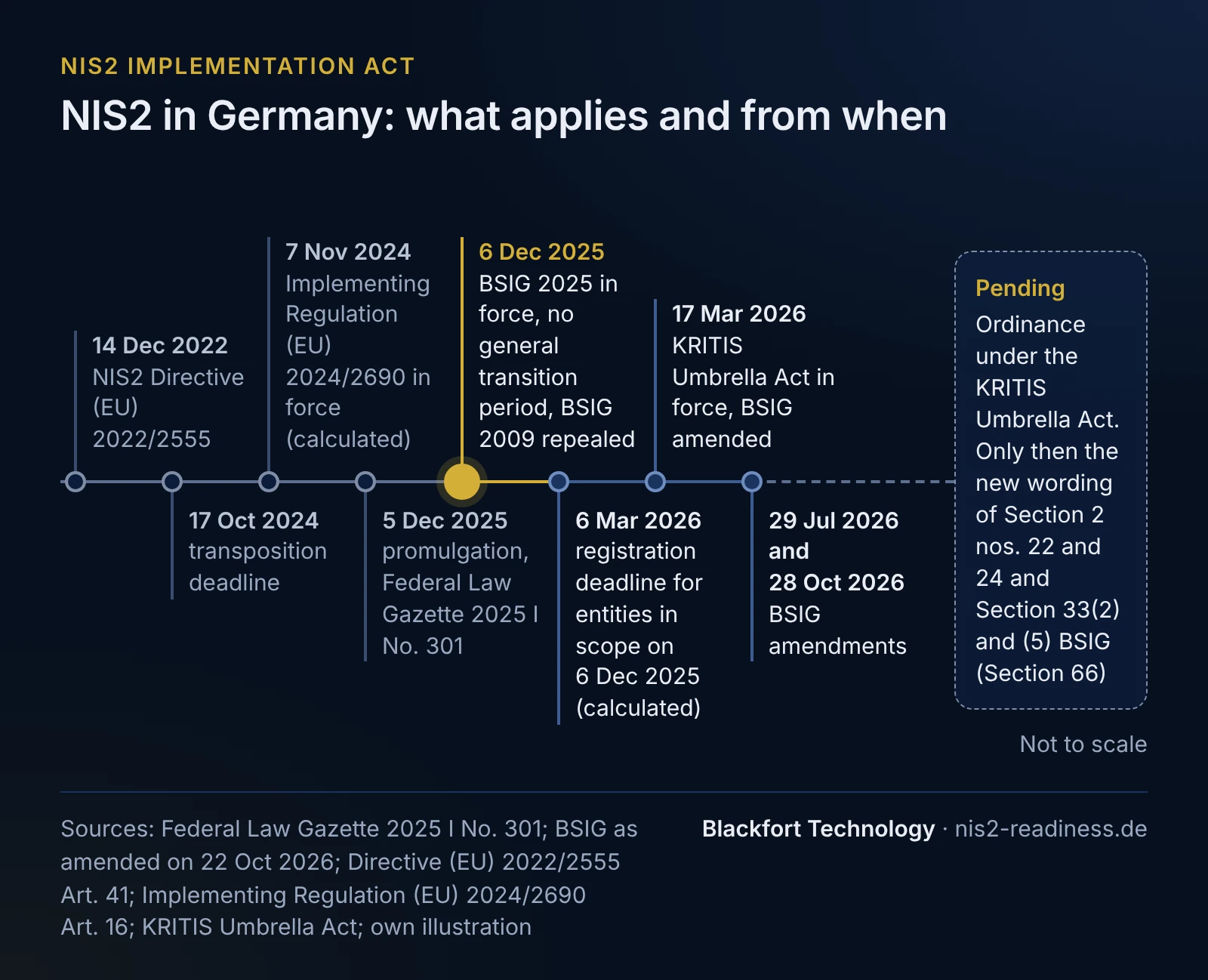
| Date | Event | What it means for companies |
|---|---|---|
| 14 Dec 2022 | NIS2 Directive (EU) 2022/2555 adopted | Member States must transpose it |
| 17 Oct 2024 | transposition deadline of the Directive, application from 18 Oct 2024 | no German act yet |
| 7 Nov 2024 (calculated) | Implementing Regulation (EU) 2024/2690 in force | requirements and significance thresholds for eleven digital entity types |
| 5 Dec 2025 | promulgation, BGBl. 2025 I No. 301 | statutory text is final |
| 6 Dec 2025 | BSIG 2025 in force, BSIG 2009 repealed | obligations under Sections 30, 32, 33 and 38 apply, no general transition period |
| 6 Mar 2026 (calculated) | three months after entry into force | end of the registration period for all entities already in scope on 6 Dec 2025; the BSI states that the period has expired |
| 17 Mar 2026 | KRITIS Umbrella Act in force, BSIG amended | framework for physical resilience; duties under it only after ordinance and registration |
| 26 Jun 2026 | BSI specification of the registration procedure, version 1.0 | binding requirements for registration in the BSI portal |
| 29 Jul 2026 | BSIG amended (Art. 9 of the Act of 21 Jul 2026) | under Section 66, Section 33(5) continues to apply in the version in force up to 28 Jul 2026 |
| 28 Oct 2026 | BSIG amended (Art. 8 of the Act of 22 Oct 2026) | current version; entity obligations unaffected |
| pending | ordinance under Sections 4(3), 5(1) KRITIS Umbrella Act | only then the new wording of Section 2 nos. 22, 24 and Section 33(2), (5) BSIG |
| 17 Oct 2027 | first review of the Directive by the Commission | possible changes at EU level, then every 36 months |
| from 6 Dec 2028 (calculated) | earliest date under Section 61(3) | the BSI can order essential entities to provide evidence |
Example: recording the legal basis for management
Fictitious example, not a client. A manufacturer of electric motors with 140 employees has classified itself as an important entity (Annex 2, manufacture of electrical equipment). Management asks the IT manager for a sheet that records the legal position and that internal policies can refer to. He records:
- Legal basis: BSIG as amended on 22 October 2026, checked on 6 November 2026 on gesetze-im-internet.de.
- Application: since 6 December 2025, no transition period; registration, risk management under Section 30 and reporting channels under Section 32 are therefore already required.
- Section 66: does not concern us, because we operate no critical facility under the BSI Critical Infrastructure Ordinance.
- Implementing Regulation 2024/2690: not applicable to us, because we are none of the eleven digital entity types; on whether an incident is significant, we use Article 3(1) as guidance, as the BSI recommends.
- Follow-up: check the version every quarter; when the BSIG changes, align policies and the reporting process.
The sheet does not replace a legal review; it makes sure all internal documents refer to the same version.
Three common misconceptions
| Misconception | Cause | Effect | Remedy |
|---|---|---|---|
| “We still have a transition period.” | Section 66 read as a general deferral | measures, documentation and reporting channels missing although the obligations have applied since 6 Dec 2025 | apply Section 66 only to the critical facility definitions and Section 33(2) and (5); check obligations against the overview of requirements |
| “Register first, implement later.” | registration seen as the starting point of the obligations | risk management under Section 30 and its documentation postponed | tackle registration and implementation in parallel; the obligations apply regardless of registration |
| “Our policy cites the NIS2UmsuCG.” | abbreviation copied from articles | the reference names no version and a term not used in the act | cite “BSIG as amended on …” and review it regularly |
This page provides general information. Whether and how your company is affected depends on the individual case and may require legal advice. If you want to know where your company stands against the BSIG obligations, the NIS2 gap analysis is the structured starting point.
Frequently asked questions
What is the NIS2UmsuCG?+
Is there a transition period for NIS2 in Germany?+
What role does the NIS2 Directive play alongside the BSIG?+
Where can I find the current statutory text?+
Read more
- NIS2 applicability in Germany: Section 28 BSIG scope check
- NIS2 requirements in Germany: BSIG obligations matrix
- NIS2 registration in Germany: BSI portal, deadline and data
- NIS2 incident reporting in Germany: Section 32 BSIG deadlines
- NIS2 and ISO 27001 in Germany: mapping, differences, gaps
- NIS2 gap analysis in three tiers: indication, gap, roadmap
Sources
- BSI Act (BSIG) of 2 December 2025, consolidated German text, last amended by Art. 8 of the Act of 22 Oct 2026 (gesetze-im-internet.de) (retrieved 2026-11-06)
- Federal Law Gazette 2025 I No. 301: German NIS2 implementation act (German) (retrieved 2026-11-06)
- Directive (EU) 2022/2555 (NIS2 Directive), EUR-Lex (retrieved 2026-11-06)
- Implementing Regulation (EU) 2024/2690, EUR-Lex (retrieved 2026-11-06)
- BSI: general NIS2 FAQ (German) (retrieved 2026-11-06)
- KRITIS Umbrella Act, consolidated German text (gesetze-im-internet.de) (retrieved 2026-11-06)
- BBK: FAQ on the KRITIS Umbrella Act (German) (retrieved 2026-11-06)
- DIHK: ministry presents draft ordinance identifying critical facility operators (German, secondary source) (retrieved 2026-11-06)
- buzer.de: BSIG amendment history (German, secondary source, dates only) (retrieved 2026-11-06)
This content provides general technical and organisational information and does not constitute legal advice (no legal services within the meaning of the German RDG).