

Last updated: 2026-11-06
The ten areas of measures are covered in detail on the Section 30 BSIG page, the order of implementation in the NIS2 implementation plan. Whether your company is in scope at all is the subject of the NIS2 applicability check.
What does NIS2 require of companies in Germany?
NIS2 is an EU directive (Directive (EU) 2022/2555). Germany transposed it through the BSI Act (BSIG), enacted by the NIS2 Implementation Act, which entered into force on 6 December 2025; this page refers to the version as amended on 22 October 2026. There is no general transition period. Section 66 BSIG defers only certain provisions on critical facilities and parts of registration; the duties under Sections 30, 32 and 38 have applied since the act entered into force, whether or not the entity has completed its registration yet.
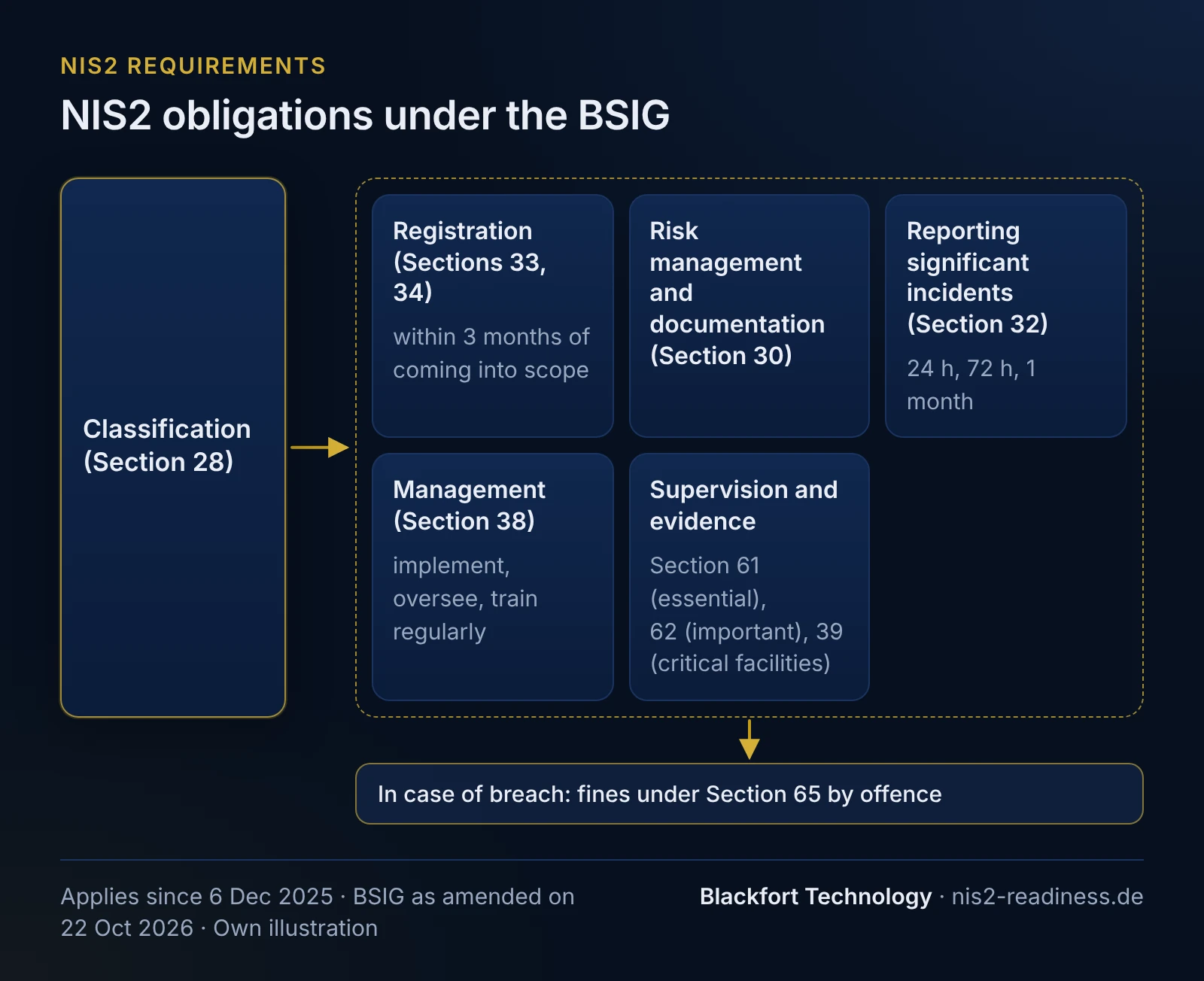
Obligations matrix: duty, legal reference, addressee, timing
“EE” means essential entities, “IE” important entities. “Since 6 Dec 2025” applies to entities in scope on that date; an entity that crosses a threshold later is in scope from that point on (our reading).
| Obligation | Legal reference | Who | From when | More |
|---|---|---|---|---|
| Assess applicability and record the result (prerequisite for everything else; the BSI does not notify you) | Section 28 BSIG, Annexes 1 and 2 | any company in one of the sectors | ongoing, whenever size or activities change | Applicability |
| Register with the BSI | Section 33(1); additionally Section 34 for certain digital entity types | EE, IE, domain name registration service providers; also entities exempted under Section 28(5) and (6) | no later than three months after coming into scope; for entities in scope on 6 Dec 2025 this was 6 March 2026 (calculated) | Registration |
| Report changes to registration data | Section 33(5), Section 34(2) | registered entities | Section 34: within three months; Section 33(5) currently applies in its version up to 28 July 2026 (Section 66) | Registration |
| Risk management measures in ten areas | Section 30(1), (2); for certain digital entity types Implementing Regulation (EU) 2024/2690 takes precedence (Section 30(3)) | EE, IE | since 6 Dec 2025 | Section 30 BSIG |
| Document compliance | Section 30(1) sentence 3 | EE, IE | since 6 Dec 2025 | Section 30 BSIG |
| Attack detection systems | Section 31(2) | operators of critical facilities | since 6 Dec 2025 | - |
| Report significant incidents: early warning (German: frühe Erstmeldung), 72-hour notification, final report (progress report if the incident is ongoing) | Section 32(1), (2) | EE, IE | since 6 Dec 2025; 24 hours and 72 hours after becoming aware, final report one month after the notification | Incident reporting |
| Inform recipients of services | Section 35(1) (when ordered by the BSI); Section 35(2) (on own initiative, certain sectors only) | EE, IE | when the case arises | Incident reporting |
| Implement the measures and oversee their implementation | Section 38(1) | management of EE and IE | since 6 Dec 2025 | Management |
| Regular training | Section 38(3) | every member of management | regularly; the act sets no interval | Management training |
| Evidence through audits, inspections or certifications | Section 39 | operators of critical facilities | every three years, date set by the BSI | - |
| Supervision: audits, inspections, on-site checks ordered by the BSI | Section 61 | EE | evidence under Section 61(3) no earlier than three years after entry into force, i.e. from 6 Dec 2028 (calculated) | Applicability (supervision by category) |
| Supervision when there are indications | Section 62 | IE, where facts suggest a breach | since 6 Dec 2025 | Applicability (supervision by category) |
| Fines by offence | Section 65 | EE, IE | since 6 Dec 2025 | table below on this page |
Exemptions: Sections 30, 32 and 38, among others, do not apply to public telecoms operators and providers or to energy companies subject to Sections 5c to 5e of the Energy Industry Act (Section 28(5)), nor to financial entities under DORA and the telematics infrastructure (Section 28(6)); registration remains mandatory in both cases. If operating an energy installation is only a secondary activity, the exemption does not apply (Section 28(5) sentence 4). Which sections are exempted and the further limits are explained in the NIS2 applicability check.
Do essential and important entities have different obligations?
Not for registration, measures, reporting or management: Sections 30, 32, 33 and 38 apply to both categories alike. The differences lie in supervision and fines. The BSI may order audits and inspections of essential entities on its own initiative (Section 61), but of important entities only where facts suggest a breach (Section 62). Maximum fines differ as shown below. Operators of critical facilities have additional duties under Sections 31 and 39.
Which fines apply to which obligation?
Maximum fines depend on the offence and the category of entity. A selection from Section 65 BSIG:
| Offence | EE | IE |
|---|---|---|
| Measures under Section 30(1) not taken or not documented; incident not reported, or not reported in time, under Section 32 | up to €10 million; with total turnover above €500 million, up to 2% of total turnover | up to €7 million; with total turnover above €500 million, up to 1.4% of total turnover |
| Registration under Section 33 or 34 not made, incorrect or late | up to €500,000 | |
For the offences in the first row the maximum is not halved for negligence (Section 65(9)). Other offences, for example regarding evidence from operators of critical facilities, carry their own maximums. Management is liable to its own entity for culpably caused damage under company law (Section 38(2)); the page on management obligations explains this.
Example: the matrix filled in for a courier company
Fictitious example, not a client. A regional courier and parcel company employs 90 people (in annual work units), has a turnover of €14 million and does not belong to a group. Postal and courier services are listed in Annex 2; with 50 or more employees the company is an important entity. Management has the matrix filled in for the company:
| Obligation | Status in the example | Next step | Owner |
|---|---|---|---|
| Classification | memo from January 2026, important entity | review annually with the year-end figures | Management |
| Registration | completed in February 2026 | report changes to contact data and IP ranges | Head of IT |
| Section 30 measures | backups and MFA in place, no risk analysis, supply chain not addressed | review all ten areas with the checklist | Head of IT, Purchasing |
| Section 30 documentation | scattered, no register | set up an evidence register | Head of IT |
| Section 32 reporting | no reporting process, reachable on weekdays only | reporting chain with deputies, check access to the BSI portal | Head of IT, Management |
| Section 38 oversight | no reporting to management | quarterly status report | Management |
| Section 38 training | no training yet | initial training for both managing directors | Management |
The matrix shows the company where it stands: registration is done, reporting and management duties are largely open. These items move to the front of the implementation plan.
Typical gaps
| Gap | Cause | Effect | Remedy |
|---|---|---|---|
| Waiting for registration before starting measures | Belief that obligations start with registration | Duties under Sections 30, 32 and 38 remain unmet although they apply | Handle registration and measures in parallel |
| No reporting capability | Incidents are handled technically, nobody owns the report to the BSI | The 24-hour deadline passes in a real incident | Reporting process with roles, deputies and out-of-hours availability |
| Management merely informed | Information security is seen as an IT topic | The oversight duty under Section 38(1) cannot be evidenced | Regular report to management with recorded decisions |
NIS2 alongside other frameworks
Other frameworks may apply alongside NIS2. The pages linked below cover each relationship in detail:
- ISO 27001: According to the BSI, a comprehensively implemented ISMS covers a large part of Section 30, but a certificate does not automatically fulfil all BSIG obligations. There is no “NIS2 certification”. See NIS2 and ISO 27001.
- IT-Grundschutz: The BSI baseline protection methodology is not mandatory for NIS2; a certification based on it can make evidence easier. See Grundschutz-Readiness: NIS2 and IT-Grundschutz (German).
- C5: Cloud providers with a C5 audit report ask what counts for NIS2. Which obligations remain is explained at C5-Readiness: C5 and NIS2 (German).
- CRA: Regulation (EU) 2024/2847 governs the cybersecurity of products with digital elements and the obligations of manufacturers and other economic operators; NIS2 governs the obligations of the entity operating IT. See CRA-Readiness: CRA, NIS2 and DORA.
- DORA: Sections 30, 31, 32, 35, 36, 38 and 39 BSIG do not apply to financial entities under DORA, but they still have to register with the BSI. How the two regimes divide in detail: DORA and NIS2.
- KRITIS Umbrella Act (KRITIS-Dachgesetz): In force since 17 March 2026, it covers the resilience of critical facilities; pure IT security incidents remain under the BSIG. There is currently no registration obligation under this act because the ordinance identifying critical facilities is still pending.
- Telecommunications: Under Section 28(5), Sections 30, 31, 32, 35, 36, 38, 39, 61 and 62 BSIG do not apply to operators of public telecoms networks and providers of publicly available telecoms services; registration remains. The rules under the Telecommunications Act are covered at Blackfort Technology: telecoms providers under NIS2 and the TKG.
The BSIG does not directly oblige suppliers that are not themselves in scope. In the BSI’s view, however, their customers must bind them to security requirements in order to meet Section 30(2) no. 4.
This page provides general information, not legal advice. Which obligations apply to your company has to be assessed case by case.
Frequently asked questions
Which obligation comes first when time is short?+
Do we have to send evidence to the BSI regularly?+
Do the requirements also apply to our suppliers?+
Who monitors compliance?+
Read more
- Section 30 BSIG: the ten NIS2 measures, with a checklist
- NIS2 implementation plan: steps, sequence and a sample plan
- NIS2 applicability in Germany: Section 28 BSIG scope check
- NIS2 registration in Germany: BSI portal, deadline and data
- NIS2 incident reporting in Germany: Section 32 BSIG deadlines
- NIS2 management obligations: Section 38 BSIG and liability
- NIS2 and ISO 27001 in Germany: mapping, differences, gaps
- NIS2 gap analysis in three tiers: indication, gap, roadmap
Sources
- BSI Act (BSIG), consolidated version as amended on 22 October 2026 (retrieved 2026-11-06)
- BSIG Section 28: essential and important entities (retrieved 2026-11-06)
- BSIG Section 32: reporting obligations (retrieved 2026-11-06)
- BSIG Section 33: registration obligation (retrieved 2026-11-06)
- BSIG Section 38: duties of management (retrieved 2026-11-06)
- BSIG Section 61: supervision of essential entities (retrieved 2026-11-06)
- BSIG Section 65: fines (retrieved 2026-11-06)
- BSIG Section 66: transitional provisions (retrieved 2026-11-06)
- Directive (EU) 2022/2555 (NIS2 Directive) (retrieved 2026-11-06)
- Regulation (EU) 2024/2847 (CRA), Art. 1 (retrieved 2026-11-06)
- BSI: general NIS2 FAQ (German) (retrieved 2026-11-06)
- BSI: one-pager NIS2 and ISO 27001, version 1.0 (German) (retrieved 2026-11-06)
- BBK: FAQ on the KRITIS Umbrella Act (German) (retrieved 2026-11-06)
This content provides general technical and organisational information and does not constitute legal advice (no legal services within the meaning of the German RDG).