

Last updated: 2026-11-06
If you are a supplier yourself and your customer asks for NIS2 evidence, read the page NIS2 for suppliers. All ten measures in Section 30(2) of the German BSI Act (BSIG), which transposes Article 21 of the NIS2 Directive (EU) 2022/2555 for essential entities (in Germany: besonders wichtige Einrichtungen) and important entities (wichtige Einrichtungen), are summarised on the Section 30 BSIG page. Legal status: BSIG as amended on 22 October 2026; general information, not legal advice.
What does Section 30(2) no. 4 BSIG require?
The act lists as a minimum measure the “security of the supply chain, including security-related aspects of the relationships with direct suppliers or service providers” (Section 30(2) sentence 2 no. 4, our translation). In Article 21(2)(d), the NIS2 Directive speaks of the relationships “between each entity and its direct suppliers or service providers”. The supply chain page of the BSI, the Federal Office for Information Security, quotes the wording of the directive; for entities in Germany, the text of the BSIG applies.
The duty puts into concrete terms the basic duty in Section 30(1): appropriate, proportionate and effective measures whose compliance must be documented. It has applied since 6 December 2025, whether or not the entity has registered with the BSI.
How should the duty be interpreted?
Three points determine the scope:
- Direct suppliers: this means the immediate suppliers and service providers. The entity reaches their subcontractors through contract clauses that are passed on.
- Vulnerabilities and development processes: the directive expressly requires entities to take into account the vulnerabilities specific to each supplier, the overall quality of their products and their cybersecurity practices, including their secure development procedures (Article 21(3)). The BSIG text does not say this, but the explanatory memorandum quoted by the BSI does: contractual agreements on risk management measures, handling of security incidents and patch management, and taking BSI recommendations on products and services into account.
- Who is obliged: the BSIG does not oblige suppliers directly. In the BSI’s view, however, the entity in scope must oblige them to meet corresponding security requirements in order to fulfil its own duties.
According to the BSI, there is no general certificate that proves the supply chain requirement is met. The BSI welcomes industry initiatives for a uniform catalogue of supplier questions. It names its CyberRisikoCheck as an initial assessment; NIS2 compliance cannot be achieved with it.
What does Implementing Regulation (EU) 2024/2690 set out?
For the eleven digital entity types for which the Implementing Regulation takes precedence under Section 30(3) BSIG (such as cloud providers, data centres and managed service providers; listed in full in the sector directory), chapter 5 of its annex regulates the supply chain in detail. For all other entities it is voluntary and a good template; the provider assessment below follows it.
| Annex point | Content (summarised) |
|---|---|
| 5.1.1 | Supply chain security policy governing relationships with direct suppliers; define and communicate the entity’s own role in the supply chain |
| 5.1.2 | Selection criteria: suppliers’ cybersecurity practices including development, ability to meet the requirements, quality and resilience of products, possibility to diversify |
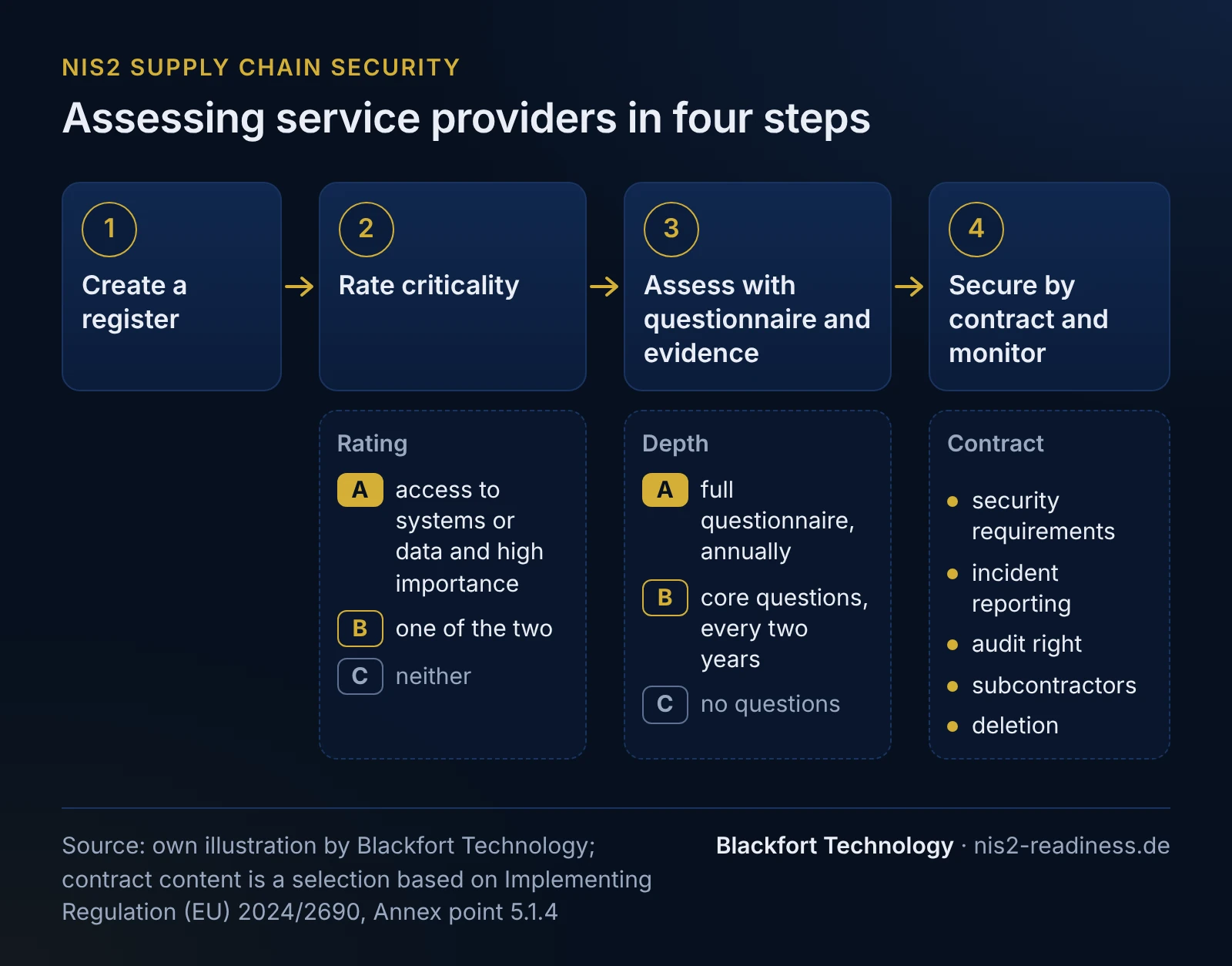
| 5.1.4 | Contract content, where appropriate: (a) security requirements, (b) training and qualifications of staff, (c) background checks, (d) notification of security incidents without undue delay, (e) right to audit or audit reports, (f) handling of vulnerabilities, (g) rules on subcontracting, (h) obligations at the end of the contract |
| 5.1.6, 5.1.7 | Review the policy, monitor changes at suppliers, evaluate incidents at suppliers, document the results |
| 5.2 | Register of direct suppliers with contact points and the ICT products, services and processes they provide |
Which ISO 27001 controls correspond to no. 4?
The BSI maps the supply chain security policy to controls A.5.19, A.5.20, A.5.21 and A.8.30 of ISO/IEC 27001:2022, and the supplier register to A.5.22. The BSI stresses that implementing these standards does not automatically meet all BSIG requirements.
| ISO/IEC 27001:2022 | Short name (ours) | Relates to |
|---|---|---|
| A.5.19 | security in supplier relationships | policy (BSI mapping) |
| A.5.20 | security in supplier agreements | policy (BSI mapping) |
| A.5.21 | security in the ICT supply chain | policy (BSI mapping) |
| A.8.30 | outsourced development | policy (BSI mapping) |
| A.5.22 | monitoring and change of supplier services | register (BSI mapping) |
| A.5.23 | security for use of cloud services | our own addition for cloud providers |
If you work with IT-Grundschutz, the classification of Grundschutz++ is on the sister site NIS2 and Grundschutz++ on grundschutz-readiness.de (German). The comparison of ISO 27001 and NIS2 as a whole is on the page NIS2 and ISO 27001.
Do we need an SBOM from our suppliers?
The BSIG, the NIS2 Directive and the Implementing Regulation do not use the term SBOM (software bill of materials). A general duty to require an SBOM from every supplier cannot be derived from them.
The texts do require information for which an SBOM is a suitable format: the directive requires supplier vulnerabilities and the quality of their products to be taken into account. For its entity types, the Implementing Regulation requires, when acquiring ICT products, “information describing the hardware and software components” and details on security updates over the lifetime (Annex point 6.1.2(b) and (c)). An SBOM provides exactly this list of components in machine-readable form and shows whether a newly disclosed vulnerability affects a product in use.
Our recommendation: for critical software (rating A), ask in the questionnaire whether the supplier is willing to provide an SBOM, and include it in the requirements for new purchases; for standard software without special access, in our view it is enough to ask about update deadlines and the support period. Which duties manufacturers have under the CRA (Regulation (EU) 2024/2847) and how this relates to NIS2 is explained on the sister site CRA, NIS2 and DORA compared on cra-readiness.de. Blackfort Technology offers creating and analysing SBOMs as a separate service: SBOM service.
Which evidence is suitable?
There is no prescribed evidence package, and evidence is only due when the BSI orders it. Suitable evidence examples, by origin:
| Origin | suitable evidence examples |
|---|---|
| Legal obligation (Section 30(1) sentence 3) | documentation that supply chain measures have been taken; the form is not prescribed |
| Obligation only for entities under the Implementing Regulation | supply chain security policy; selection criteria; register of direct suppliers; contracts with the content under Annex point 5.1.4, where appropriate |
| Professional recommendation (BSI) | agreements with service providers on risk management, handling of security incidents and patch management; requirements based on security by design and security by default |
| Blackfort example | provider register with ratings, completed supplier questionnaires, assessment sheet with decision and review date, contract amendments |
Example: a waste management company with eight service providers
Fictitious example, not a client. A waste management company with 140 employees falls under Annex 2 (waste management) and is an important entity. An IT service company runs servers and firewall, the industry software runs as a cloud service, the vehicles report their routes to a telematics platform, and the manufacturer maintains the weighbridge via remote access. On top of that come payroll, a printer service, building cleaning and a workwear supplier.
The company creates a register, rates each provider by access and importance and only sends questionnaires to the critical ones.
Work product 1: service provider assessment
Rating: A = access to systems or data and high importance for the entity’s own services; B = one of the two; C = neither. A gets the full questionnaire with evidence and is reviewed annually, B the core questions every two years, C no questionnaire.
| Service provider | Service | Access | Rating | Questionnaire result | Contract: incident reporting, audit right, subcontracting, deletion | Action, deadline |
|---|---|---|---|---|---|---|
| IT service company | operation of servers, firewall, backup | administrator access | A | ISO 27001, service within scope; MFA yes; reporting time 24 h | reporting duty missing, audit right missing | contract amendment, 31 January 2027 |
| Industry software (cloud) | order processing, billing | all customer data | A | C5 audit report available; data centre in the EU; deletion at end of contract agreed | complete | review 11/2027 |
| Telematics platform | route planning, vehicle tracking | vehicle and route data | A | no certification; MFA optional only; update deadlines unclear | reporting duty missing | enable MFA, amendment, talk about update deadlines, 28 February 2027 |
| Weighbridge manufacturer | maintenance via remote access | weighbridge computer | A | remote access permanently open, shared password | audit right missing | access only on request with MFA and logging, 31 December 2026 |
| Payroll | salary processing | personnel data | B | core questions met | complete | review 11/2028 |
| Printer service | maintenance of multifunction devices | devices in the network | B | core questions met except MFA | reporting duty missing | devices in a separate network segment, 31 March 2027 |
| Building cleaning | cleaning | physical access, no IT access | C | no questionnaire | confidentiality clause in place | - |
| Workwear | delivery | none | C | no questionnaire | - | - |
The result: four A-rated providers; three lack contract clauses and two lack technical minimum standards. Remote maintenance of the weighbridge is the largest open risk. How to secure remote access by service providers technically is described by Blackfort Technology on the page secure remote access. The open points go into the risk analysis as risks.
Work product 2: supplier questionnaire
The questionnaire contains 27 questions in twelve areas, 12 of them core questions for rating B. Each question names its reference to Section 30(2) BSIG, the directive or the annex of the Implementing Regulation. The Excel file has a cover sheet with instructions, a sheet for the supplier’s details, the questionnaire with drop-down fields and an assessment sheet for the customer. The file is available in German only.
Download the German-language questionnaire (Excel, version 1.1, as of 6 November 2026)
You may use and adapt this template within your own company and pass it on to your suppliers and service providers. Publishing or reselling it is not permitted.
Excerpt (core questions, translated):
| No. | Question | Reference |
|---|---|---|
| A1 | Is there a named person or function responsible for information security? | Section 30(2) no. 1 BSIG |
| A4 | Which certificates or audit reports exist, with which scope, and is the service you provide to us included? | evidence |
| C2 | Do you notify us without undue delay of security incidents that may affect our systems, data or the agreed service? Within what time after becoming aware? Is this agreed in the contract? | Implementing Regulation, Annex point 5.1.4(d) |
| D1 | Is our data backed up, and is recovery tested regularly? | Section 30(2) no. 3 BSIG |
| E1 | Do you use subcontractors with access to our data or systems? | Implementing Regulation, Annex point 5.1.4(g) |
| F1 | Is there a security update process with fixed deadlines by criticality? | Section 30(2) no. 5 BSIG |
| G2 | Do your employees use multi-factor authentication to access our systems? | Section 30(2) no. 10 BSIG |
| K2 | Do you grant us a right to audit or provide audit reports? | Implementing Regulation, Annex point 5.1.4(e) |
The questionnaire is a working aid and does not replace contractual provisions. Answers without evidence are self-declarations; for rating A you should ask for proof, such as a certificate with its scope, a test record or a policy. An ISO 27001 certificate is good evidence if the service you receive is within its scope; it does not replace contract clauses such as the reporting duty. How suppliers use certificates as evidence is shown on the page NIS2 for suppliers.
Three typical gaps
| Gap | Cause | Effect | Remedy |
|---|---|---|---|
| Same questionnaire for everyone | No rating by criticality. | High effort, unanswered questionnaires, and the important providers are not examined more closely. | register with ratings A, B, C; depth of assessment by rating |
| Contracts without security clauses | Legacy contracts and the provider’s standard terms. | The entity learns of an incident at the provider late or not at all; its own reporting deadline runs regardless. | amendment with reporting duty, audit right, subcontracting rules and deletion |
| Assessed once, register out of date | The assessment was a project and purchasing is not involved. | New cloud services and remote access are added without review. | assessment as a step in the purchasing process, review dates by rating |
How Blackfort Technology helps
We set up the provider register with you, rate the providers, evaluate the questionnaires and draft the technical requirements for contract amendments. The legal drafting of the contracts stays with your legal counsel. The starting point is the NIS2 gap analysis.
Frequently asked questions
Do we have to assess all suppliers under NIS2?+
Is our service provider itself subject to NIS2?+
Is there an official NIS2 supplier questionnaire from the BSI?+
What about our service providers’ subcontractors?+
Read more
Sources
- Section 30 BSIG: risk management measures (gesetze-im-internet.de, German) (retrieved 2026-11-06)
- NIS2 Directive (EU) 2022/2555, Article 21(2) and (3) (retrieved 2026-11-06)
- Implementing Regulation (EU) 2024/2690, Annex points 5 and 6.1 (retrieved 2026-11-06)
- BSI: info package “Sichere Lieferkette” with ISO 27001:2022 mapping (German) (retrieved 2026-11-06)
- BSI: general NIS‑2 FAQ (supply chain, suppliers, evidence on order; German) (retrieved 2026-11-06)
This content provides general technical and organisational information and does not constitute legal advice (no legal services within the meaning of the German RDG).