

Last updated: 2026-11-06
Which obligations essential entities (in Germany: besonders wichtige Einrichtungen) and important entities (wichtige Einrichtungen) have is covered in the overview of NIS2 requirements; what the ten areas of measures require in detail is on the page on Section 30 BSIG, with a checklist.
Do we have twelve months to implement?
No. The BSIG entered into force with the NIS2 implementation act on 6 December 2025 and has no general transition period; according to the BSI, the Federal Office for Information Security, entities in scope must in principle meet their obligations immediately. A plan does not change this. It is the tool you use to close existing gaps in an orderly way and to show management and the supervisory authority that you are doing so.
The NIS2 Directive also requires member states to ensure that an entity which finds that it does not comply with the measures takes all necessary corrective measures without undue delay (Article 21(4) of Directive (EU) 2022/2555). The BSIG does not contain this wording; professionally, it is the right yardstick. For the plan this means: whatever is quick and effective comes immediately, even if the overall project takes longer.
Which immediate measures come first?
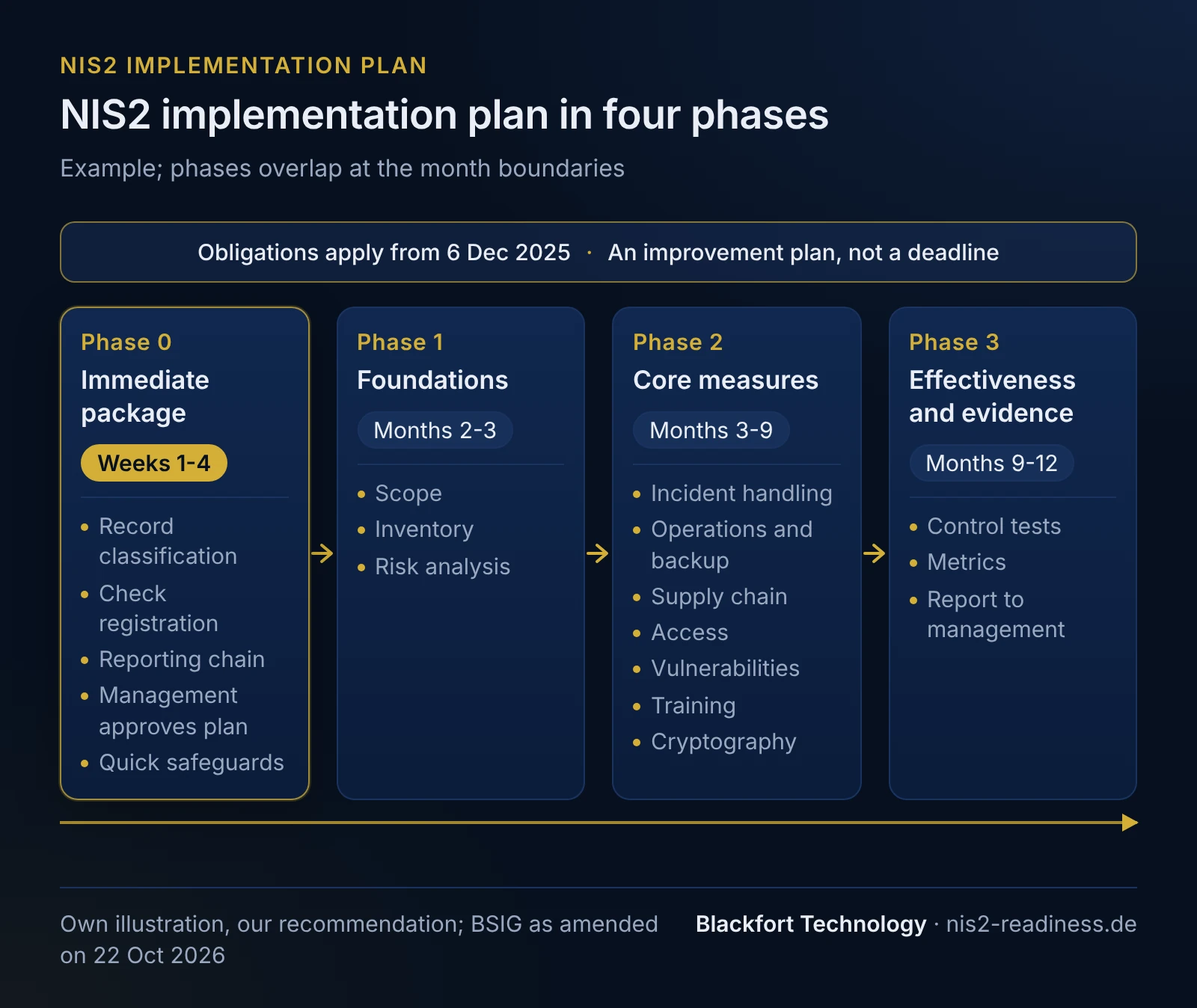
The immediate package contains obligations with short deadlines, management responsibility and technical safeguards that work without lengthy concept work. The selection is our recommendation; the law does not prescribe an order.
| Immediate measure | Why first | Provision | More |
|---|---|---|---|
| Check the classification and record it in writing | The BSI does not tell you whether you are in scope; the entity classifies itself. Everything else depends on it. | Section 28 BSIG | applicability |
| Check registration and catch up if it is outstanding | Deadline three months after coming into scope; for entities in scope on 6 December 2025 it has passed, and the BSI calls for immediate registration. | Section 33 BSIG | registration |
| Set up the reporting chain: who detects, who decides, who reports, who deputises | The early warning is due no later than 24 hours after becoming aware; the BSI expects alerting routes outside business hours as well. | Section 32 BSIG | incident reporting |
| Management body approves plan, roles and budget | The management body must implement the measures and oversee their implementation; without a decision, both are missing. | Section 38(1) BSIG | management body |
| Schedule training for the management body | Every member of the management body must be trained regularly; the BSI recommends a thorough initial training. | Section 38(3) BSIG | management training |
| Quick safeguards: MFA for remote access and administrator accounts, check that backups are stored separately | Both fall under Section 30(2) no. 10 and no. 3 respectively and close known attack routes before the risk analysis is finished (professional recommendation). | Section 30(2) BSIG | Section 30 BSIG |
According to the BSI, an entity that suffers a significant incident before registering reports it through an online form in the reporting and information portal (Melde- und Informationsportal, MIP). The reporting chain should therefore not wait for registration.
In what order do the further steps follow?
Three phases follow the immediate package. The order results from dependencies: no risk analysis without an inventory, no reasoned choice of measures without a risk analysis. Section 30(1) sentence 2 measures proportionality by, among other things, risk exposure; the risk analysis provides the basis for this.
- Foundations: define the scope (the entire entity), inventory of systems, services and service providers, risk analysis with treatment plan.
- Core measures: the ten areas under Section 30(2), prioritised according to the treatment plan.
- Effectiveness and evidence: control tests, metrics, report to the management body, update of the plan.
What depends on what?
| Step | requires | because |
|---|---|---|
| Risk analysis | inventory of systems, processes and service providers | only known assets can be assessed |
| Choice and scope of measures | risk analysis with treatment plan | proportionality must be justifiable |
| Adjusting supplier contracts | supplier register with criticality | contracts are prioritised by the supplier’s importance |
| Reporting exercise | incident process with roles and reporting chain | an exercise tests a documented procedure |
| Restore test | backup concept and recovery objectives | the test needs a target to measure against |
| Effectiveness assessment | measures that have been running for a while | what is assessed is day-to-day operation |
| Report to the management body | status per work package with evidence | oversight under Section 38(1) relies on it |
Who is responsible?
Legally, the management body is responsible (Section 38(1)). The other roles are our recommendation for companies with a small IT team:
| Role | Task in the plan |
|---|---|
| Management body | approves plan and budget, signs off the status monthly or quarterly, decides on the risks that remain |
| Person responsible for information security | steers the plan, maintains the risk analysis and evidence register, reports to the management body; internal or as an external information security officer |
| Head of IT or IT service provider | technical implementation, backup, access, patches, MFA |
| Purchasing | supplier register, security clauses in contracts |
| HR | joiners and leavers, staff training |
| Business units, production | assess the impact of outages, contribute to emergency plans |
An IT service provider can also be authorised to report to the BSI. According to the BSI, responsibility for the incident and the content of the report remains with the entity.
How do you know a work package is done?
Each package needs a verifiable completion criterion and evidence. Without both, the management body cannot oversee progress. Examples (our recommendation):
| Work package | Completion criterion | Evidence |
|---|---|---|
| Classification | result with reasoning in writing, confirmed by the management body | classification record |
| Reporting chain | roles, deputies and round-the-clock availability defined, access to the reporting channel tested | reporting process, alerting list |
| Risk analysis | all processes in scope assessed, treatment plan approved | risk register, approval note |
| Backup and recovery | restore of a critical system tested, result assessed against the objective | test record |
| Supply chain | critical suppliers assessed, security clauses in new and renewed contracts | supplier register, contract template |
| Effectiveness | first control tests carried out, deviations assigned to corrective actions | audit report, metrics |
Sample 12-month plan (improvement plan, no deadline)
Fictitious example, not a client. A food manufacturer with 140 employees and industrial production is classified as an important entity (Annex 2). Registration is done, otherwise little documentation exists; IT is run by two in-house employees and an external IT service company.
Important: The following plan is an improvement plan. It describes the order in which the company closes existing gaps. It sets no deadlines for the legal obligations; these have applied since 6 December 2025.
| Month | Work package | Responsible | Prerequisite | Completion criterion |
|---|---|---|---|---|
| 1 | immediate package: classification record, reporting chain, MFA for remote access and administrators, backup check, plan approved | managing directors, head of IT | - | record signed, reporting chain tested, MFA report available |
| 1-2 | initial training of the managing directors | managing directors | - | attendance record per person |
| 2-3 | inventory and risk analysis | information security | approval in month 1 | treatment plan approved |
| 3-4 | incident process and first reporting exercise | head of IT, information security | reporting chain | exercise record with improvements |
| 3-6 | supplier register, assessment, contract clauses | purchasing | inventory | critical suppliers assessed |
| 4-6 | emergency manual and restore test of production control | head of IT, production | risk analysis | test record |
| 4-8 | authorisation concept and review, patch and vulnerability process | head of IT, IT service company | inventory | review recorded, deadlines by severity in force |
| 5-8 | staff training and awareness | HR | - | participation rate documented |
| 6-9 | cryptography concept, rules for communication channels | head of IT | inventory | concept approved |
| 9-11 | control tests and metrics | information security | measures in operation | audit report |
| 12 | report to the managing directors, plan for the following year | information security, managing directors | audit report | decision of the managing directors |
A smaller company with fewer systems progresses faster; a larger one with many sites needs longer. Duration and scope depend on the starting point, so treat the plan as a template to adapt.
Typical gaps in the implementation plan
| Gap | Cause | Effect | Remedy |
|---|---|---|---|
| The plan is read as a grace period | The schedule is confused with a legal deadline. | Simple measures are left for months although the obligations apply. | Bring the immediate package forward, adopt the plan explicitly as an improvement plan. |
| Technology before risk analysis | Products are bought before the risks are known. | Spending without justification; gaps elsewhere remain. | Risk analysis before larger investments, immediate measures excepted. |
| Packages without a completion criterion | Tasks such as “improve backup” without a measurable goal. | Progress cannot be checked; oversight by the management body stays a formality. | Define a criterion and evidence for each package, report status with evidence. |
This page provides general information and is not legal advice. Which obligations apply to your company and how urgent individual gaps are has to be assessed in the individual case.
Frequently asked questions
When must the NIS2 measures be in place?+
Does the implementation plan have to be submitted to the BSI?+
Who has to approve the plan?+
Can we start from ISO 27001 or an existing ISMS?+
How long does implementation take?+
Read more
- Section 30 BSIG: the ten NIS2 measures, with a checklist
- NIS2 requirements in Germany: BSIG obligations matrix
- NIS2 applicability in Germany: Section 28 BSIG scope check
- NIS2 registration in Germany: BSI portal, deadline and data
- NIS2 incident reporting in Germany: Section 32 BSIG deadlines
- NIS2 management obligations: Section 38 BSIG and liability
- NIS2 gap analysis in three tiers: indication, gap, roadmap
Sources
- BSI Act (BSIG), consolidated version, last amended by Article 8 of the Act of 22 October 2026 (German) (retrieved 2026-11-06)
- BSIG Section 30: risk management measures (German) (retrieved 2026-11-06)
- BSIG Section 32: reporting obligations (German) (retrieved 2026-11-06)
- BSIG Section 38: duties of the management body (German) (retrieved 2026-11-06)
- Directive (EU) 2022/2555 (NIS2 Directive), Article 21(4) (retrieved 2026-11-06)
- BSI: general NIS‑2 FAQ (German) (retrieved 2026-11-06)
- BSI: NIS‑2 regulated companies (overview, registration, German) (retrieved 2026-11-06)
- BSI: NIS‑2 info package on reporting obligations (German) (retrieved 2026-11-06)
- BSI: training for management bodies (guidance), version 1.0 (German) (retrieved 2026-11-06)
This content provides general technical and organisational information and does not constitute legal advice (no legal services within the meaning of the German RDG).