
Last updated: 2026-11-06
This directory maps business activities to the entity types of the German BSI Act (BSIG, as amended on 22 October 2026), which transposes the NIS2 Directive (EU) 2022/2555. It does not replace a classification: whether an organisation is actually in scope, and in which category, also depends on size, group affiliation and exemptions. That check, with a completed classification record, is on the page on NIS2 applicability. German law uses two categories: essential entities (in Germany: besonders wichtige Einrichtungen) and important entities (wichtige Einrichtungen).
How do you read Annexes 1 and 2?
Each row of the annexes names a sector, sometimes a subsector, and the entity type. The entity type is what you test against. Some entity types refer to German sector legislation (for example “operators of gas distribution networks under Section 3 no. 8 of the Energy Industry Act”), others to a division of the NACE Rev. 2 classification. Which version of the classification applies and which code from your statistical returns to use is explained in the applicability check.
For the category: Annex 1 entity types are essential or important depending on size, Annex 2 entity types are at most important. Trust service providers, telecommunications providers, DNS service providers and TLD name registries follow their own rules, some of them independent of size, although they are listed in Annex 1.
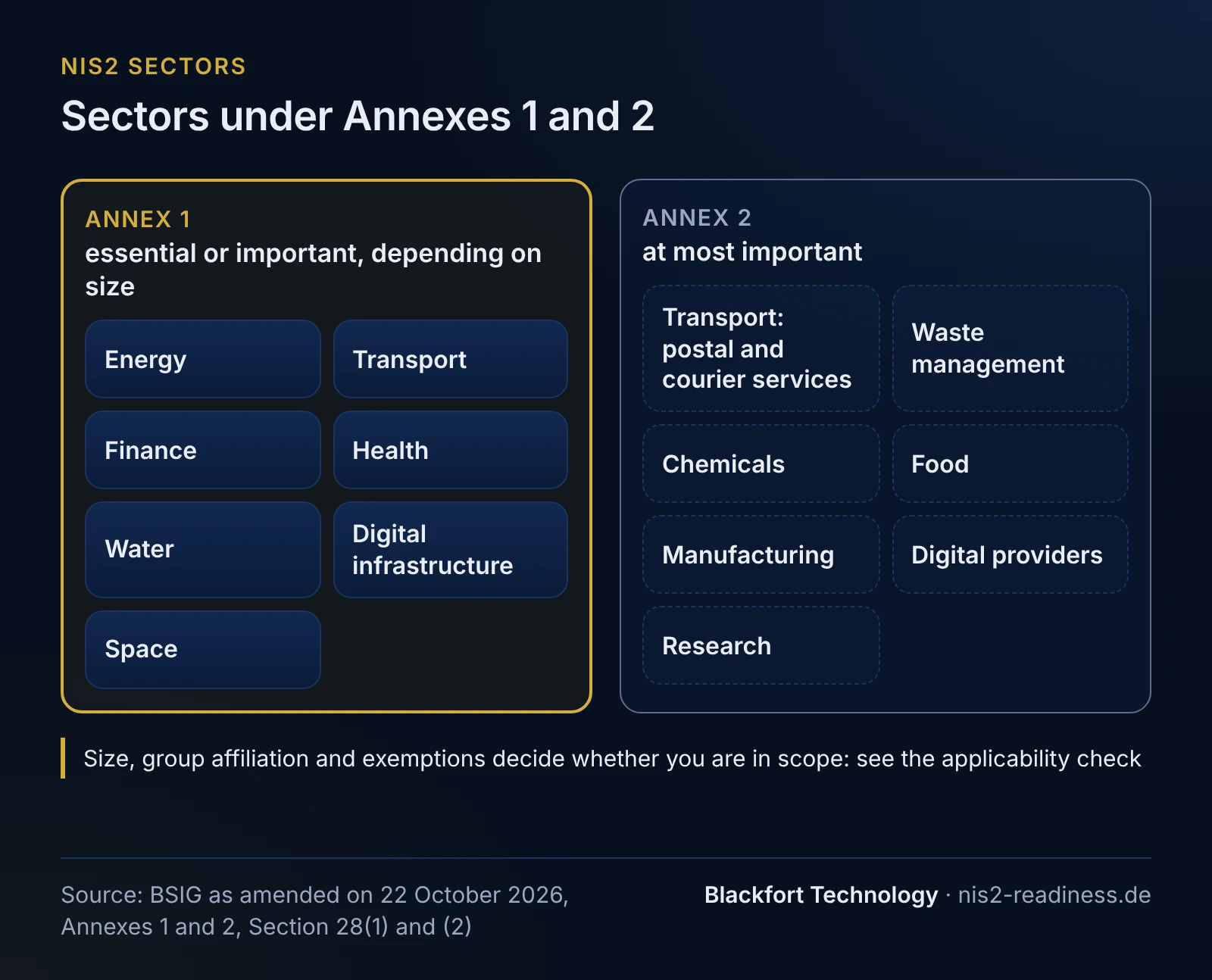
Annex 1: sectors of essential and important entities
The table summarises the entity types close to the statutory wording, numbered as in the annex. Only the German statutory text is binding; the English terms are our own rendering.
| Sector | Subsector | Entity types (no.) |
|---|---|---|
| Energy | Electricity | electricity suppliers, operators of electricity distribution and transmission networks, operators of generating installations, nominated electricity market operators, aggregators, operators of energy storage facilities, balancing service providers, charging point operators under the German Charging Station Ordinance (1.1.1-1.1.9) |
| Energy | District heating and cooling | operators of district heating or cooling supply under the German GModG (1.2.1) |
| Energy | Oil | operators of oil transmission pipelines, of installations for the production, refining and treatment of oil and of oil storage facilities, central stockholding entities (1.3.1-1.3.3) |
| Energy | Gas | operators of gas distribution networks, transmission networks, storage facilities and LNG facilities, gas suppliers, operators of installations for the production, refining and treatment of natural gas, operators in hydrogen production, storage and transmission (1.4.1-1.4.8) |
| Transport | Air | commercial air carriers, airport managing bodies and airports including entities operating ancillary installations there, ATM/ANS providers (2.1.1-2.1.3) |
| Transport | Rail | railway infrastructure managers, railway undertakings including operators of service facilities (2.2.1, 2.2.2) |
| Transport | Water | inland, sea and coastal passenger and freight transport companies (not the individual vessels), managing bodies of ports and operators of installations within ports, operators of installations or systems for the safe operation of a waterway (2.3.1-2.3.3) |
| Transport | Road | operators of installations or systems for traffic management, such as traffic, operations and tunnel control centres, operators of intelligent transport systems (2.4.1, 2.4.2) |
| Finance | Banking | credit institutions (3.1.1) |
| Finance | Financial market infrastructures | trading venues, central counterparties (3.2.1, 3.2.2) |
| Health | - | healthcare providers under Directive 2011/24/EU, EU reference laboratories, undertakings carrying out research and development of medicinal products, manufacturers of basic pharmaceutical products and preparations (NACE division 21), manufacturers of medical devices considered critical during a public health emergency (4.1.1-4.1.5) |
| Water | Drinking water | operators of water supply installations under the German Drinking Water Ordinance, excluding suppliers for whom water is a non-essential part of their supply of other goods (5.1.1) |
| Water | Waste water | undertakings collecting, disposing of or treating waste water, excluding those for whom this is a non-essential part of their activity (5.2.1) |
| Digital infrastructure | - | internet exchange point providers, DNS service providers (excluding root name servers), TLD name registries, cloud computing service providers, data centre service providers, content delivery network providers, trust service providers, providers of public telecommunications networks, providers of publicly available telecommunications services, managed service providers, managed security service providers (6.1.1-6.1.11) |
| Space | - | operators of ground-based infrastructure owned, managed and operated by Member States or private parties that supports space-based services, excluding providers of public electronic communications networks (7.1.1) |
Annex 2: sectors of important entities
| Sector | Entity types (no.) |
|---|---|
| Transport: postal and courier services | postal service providers under the German Postal Act, including courier service providers (1.1.1) |
| Waste management | undertakings carrying out waste management under the German Circular Economy Act, excluding those for whom waste management is not their principal economic activity (2.1.1) |
| Manufacture, production and distribution of chemicals | manufacturers and importers of substances and mixtures under REACH, provided they fall under NACE category 20 and are subject to registration under Article 6 REACH (3.1.1) |
| Production, processing and distribution of food | food businesses engaged in wholesale distribution and industrial production and processing (4.1.1) |
| Manufacturing | manufacturers of medical devices and in vitro diagnostic medical devices (except the critical medical devices covered by Annex 1); undertakings in NACE divisions 26 (computer, electronic and optical products), 27 (electrical equipment), 28 (machinery), 29 (motor vehicles and parts), 30 (other transport equipment) (5.1.1-5.6.1) |
| Digital providers | providers of online marketplaces, online search engines and social networking service platforms (6.1.1-6.1.3) |
| Research | research organisations (7.1.1) |
Borderline cases by sector
Energy: activity-based, registration remains
Organisations that operate energy supply networks, energy installations or digital energy services under the German Energy Industry Act (EnWG) and are subject to its Sections 5c to 5e are exempt from most BSIG obligations under Section 28(5) BSIG; registration under Section 33 remains. The exemption only reaches as far as the activity: obligations apply to further critical facilities and further Annex 1 or 2 activities. If operating the energy installation is only a secondary activity, the exemption does not apply at all (Section 28(5) sentence 4). Which sections exactly are disapplied is set out in the applicability check.
A municipal utility is therefore never exempt across the board: its electricity and gas networks may fall under the exemption, a drinking water supply or waste water operation in the same company does not. According to the BSI (Federal Office for Information Security), operators of energy supply networks under Section 5d(4) EnWG that are neither essential nor important entities also register. For energy suppliers and municipal utilities it pays to map each line of business separately; OT and EnWG implementation as a service is described on our energy and critical infrastructure page.
Telecommunications
Telecommunications network operators and service providers have their own size rules in Section 28 and special rules under the German Telecommunications Act (TKG), which we explain on the page German security obligations for telecom providers.
Finance: DORA takes precedence
For financial entities under Article 2(2) of the DORA Regulation (EU) 2022/2554, Sections 30, 31, 32, 35, 36, 38 and 39 BSIG do not apply (Section 28(6) no. 1). According to the BSI, they still have to register; that is the core of the NIS2 and DORA boundary. Details: DORA and NIS2.
Health and medical devices
The German telematics agency (gematik) and operators of certain telematics infrastructure services are exempt from the same sections as DORA entities (Section 28(6) no. 2). For medical devices, the line runs between the annexes: manufacturers of medical devices considered critical during a public health emergency are in Annex 1, all other manufacturers of medical devices and in vitro diagnostics in Annex 2. Hospitals, medical care centres and laboratories are assigned via the entity types of the health sector in Annex 1.
Digital infrastructure and digital providers
For DNS service providers, TLD name registries, cloud computing and data centre services, content delivery networks, managed service providers, managed security service providers, online marketplaces, online search engines, social networking platforms and trust service providers, Implementing Regulation (EU) 2024/2690 takes precedence over the measures in Section 30(2) (Section 30(3)). A similar but not identical group has to register additionally under Section 34; that list includes domain name registration service providers but not trust service providers.
Under Section 2 no. 26 BSIG, a managed service provider is a provider of services for the installation, management, operation or maintenance of ICT products, networks, infrastructure or applications, on the customer’s premises or remotely. Traditional IT system houses can therefore be covered. In the BSI’s reading, an in-house group IT that only serves its own group can be negligible. Managed service providers are also subject to Implementing Regulation (EU) 2024/2690. When an IT service provider counts as an MSP is covered on the page on IT service providers and MSPs; digital providers are covered on the page on digital services. Which NIS2 obligations remain despite a C5 audit report is answered by C5 and NIS2 on c5-readiness.de (in German).
Space: ground infrastructure only
Only operators of ground-based infrastructure that supports space-based services and is owned by Member States or private parties are covered; providers of public electronic communications networks are excluded. The annex does not list providers of space-based services as such. Background is in our article NIS2 in the space sector.
Water, waste, food, chemicals
- Water and waste water: undertakings for which supplying water or treating waste water is only a non-essential part of their activity are not covered.
- Waste: only undertakings whose principal economic activity is waste management are covered. A manufacturer disposing of its own waste is not.
- Food: the entity type names wholesale distribution and industrial production and processing. It does not name retail or catering.
- Chemicals: covered are manufacturers and importers under REACH operating in NACE category 20 that are subject to registration under Article 6 REACH.
Research
Research organisations are listed in Annex 2. Under Section 2 no. 12 BSIG, educational institutions do not count as research organisations.
Public administration: not a sector of its own
Public administration is not a sector in the annexes. Three separate routes apply:
- Federal administration: Section 29 BSIG governs it separately. Federal authorities follow the rules for essential entities, without Sections 38, 40 (3), 61 and 65; the Federal Foreign Office, the Federal Ministry of Defence, the Federal Intelligence Service and the Federal Office for the Protection of the Constitution are additionally exempt from Sections 30, 33 and 35, among others.
- State and local administration: the federal states regulate the cyber security of state and municipal administrations. For questions, the BSI refers to the competent supervisory authority of the respective state administration.
- Municipal companies: when municipally owned operations fall under the BSIG despite state law, and when Section 28(8) exempts municipal administrative service providers, is explained in the applicability check.
Example: mapping a company with several activities
Fictitious example, not a client. A food wholesaler supplies restaurants and canteens. On its premises it runs a rooftop solar system for its own consumption and eight charging points that visitors can use for a fee. An external provider manages its IT. This is how the wholesaler maps its activities:
| Activity | Mapping | Reasoning |
|---|---|---|
| Food wholesale | Annex 2 no. 4.1.1 | food business in wholesale distribution |
| Solar for own consumption | disregarded | internal purpose, negligible in the BSI’s reading (Section 28(3)) |
| Charging points for a fee | possibly Annex 1 no. 1.1.9 | offered on the market, hence not negligible in the BSI’s reading; whether the wholesaler is a charging point operator within the meaning of the Charging Station Ordinance has to be checked in the individual case |
| IT run by an external provider | no entity type of its own | the wholesaler provides no IT services to others; the provider checks its own classification |
The example shows why a secondary activity can change the category: through wholesale alone, the company would be at most important. With an Annex 1 activity added, “essential” becomes possible if it is large enough. Size, group and category are checked in a second step on the page on NIS2 applicability. This mapping is our own assessment and does not replace a legal review.
Three typical mapping errors
| Error | Cause | Effect | Remedy |
|---|---|---|---|
| Only the main activity checked | mapping via the trade association or the company’s own description | an Annex 1 secondary activity goes unnoticed, the category is too low | check every activity offered on the market against both annexes |
| Wrong classification | mapping by the newer NACE Rev. 2.1 or by the company’s own industry description | wrong division, wrong answer to “Annex 2 or not” | use the classification described in the applicability check |
| Exemption read as “out of scope” | Section 28(5) or (6) understood as disapplying the whole act | registration is not made although it remains | read exemptions section by section; registration under Section 33 remains in both cases |
Frequently asked questions
Which entity type does a secondary activity belong to?+
Is a municipal utility exempt from NIS2?+
Are supermarkets covered by the food sector?+
Is a medical device manufacturer in Annex 1 or Annex 2?+
Are municipalities covered by NIS2 in Germany?+
Read more
Sources
- BSI Act (BSIG), consolidated version, last amended 22 October 2026, Sections 2, 28, 29, 30, 34 and Annexes 1 and 2 (German) (retrieved 2026-11-06)
- BSI: general NIS‑2 FAQ (scope, registration, NACE codes, sector-specific questions), in German (retrieved 2026-11-06)
- BSI: NIS‑2 applicability check (non-binding tool), in German (retrieved 2026-11-06)
This content provides general technical and organisational information and does not constitute legal advice (no legal services within the meaning of the German RDG).