

Last updated: 2026-11-06
This page covers the duties of management under Section 38 of the German BSI Act (BSIG), which transposes Article 20 of the NIS2 Directive (EU) 2022/2555. The BSIG applies to essential entities (in Germany: besonders wichtige Einrichtungen) and important entities (wichtige Einrichtungen). The training duty in Section 38(3) is covered on the page on NIS2 training for management; the measures required by Section 30 in detail are on the Section 30 BSIG page, and all obligations at a glance in the overview of NIS2 requirements. This is general information on the BSIG as amended on 22 October 2026, not legal advice; individual cases need a legal assessment.
What does Section 38 BSIG say?
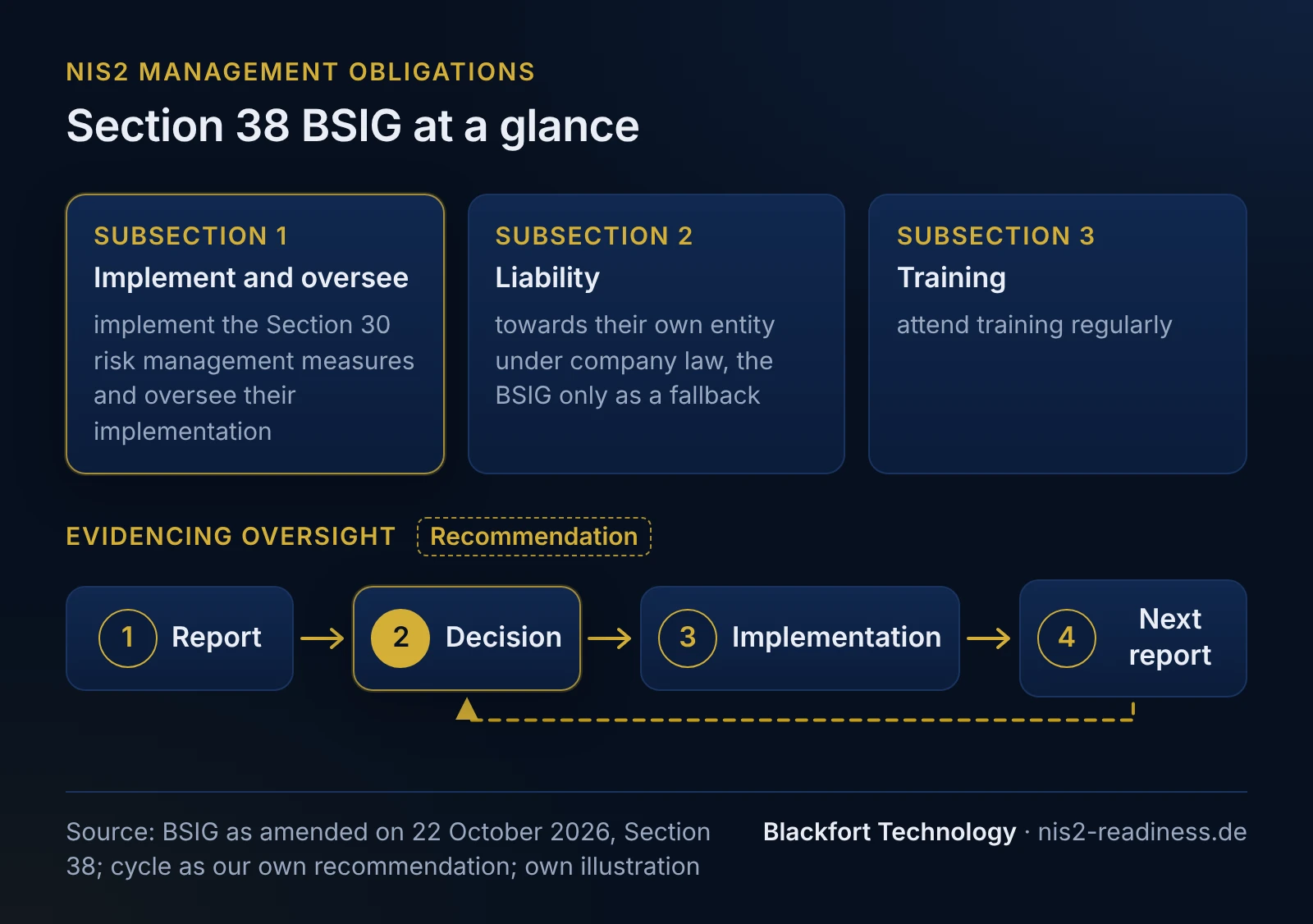
Section 38 has three subsections on implementation, liability and training. It has applied since 6 December 2025 with no general transition period, whether or not the entity has already registered with the BSI, the Federal Office for Information Security.
| Subsection | Content | What it means in practice |
|---|---|---|
| (1) | Management is obliged to implement the risk management measures to be taken under Section 30 and to oversee their implementation. | Adopt measures, provide resources, ask for the status regularly, decide when things deviate |
| (2) | If management breaches these duties, it is liable to its entity for culpably caused damage under the company law of the legal form; under the BSIG only where company law has no such rule. | Internal liability towards the own company, see below |
| (3) | Management must attend training regularly. | Training for every member of management, keep the evidence (details) |
Management within the meaning of the BSIG is every natural person appointed by law, articles of association or partnership agreement to run the business and represent the entity (Section 2 no. 13). In a GmbH these are the managing directors, in an AG the members of the management board.
The NIS2 Directive words this slightly differently in Article 20(1): there, management bodies “approve” the measures and oversee their implementation. By saying “implement”, the German act asks for more than an approval. For entities in Germany, the wording of the BSIG applies.
What do “implement and oversee” mean day to day?
Implementing means that management ensures the Section 30 measures are actually taken: appropriate, proportionate and effective technical and organisational measures whose compliance the entity documents (Section 30(1)). Overseeing means being informed about the status at regular intervals and stepping in when something is not working.
In our view, five activities belong to this, and no company can hand them off completely:
- Set objectives and boundaries: adopt the security policy and the risk appetite, that is, decide which risks the company is not willing to take.
- Assign responsibilities: appoint a person who is responsible for information security and reports directly to management.
- Provide resources: approve the budget, working time and service providers the action plan needs.
- Ask for the status: receive and read a report at fixed intervals.
- Decide: resolve delays, conflicting goals and remaining risks instead of leaving them open.
For the eleven digital entity types covered by Implementing Regulation (EU) 2024/2690 (such as cloud providers, data centres and managed service providers, listed in full in the sector directory), this is set out in more detail. For all other entities these rules are voluntary and serve as a useful benchmark:
| Requirement of the Implementing Regulation | Annex point |
|---|---|
| At least one person is directly accountable to the management bodies for network and information security. | 1.2.3 |
| The management bodies are informed of the status regularly. | 2.2.1 |
| The security policy is reviewed at least annually. | 1.1.2 |
| The management bodies or authorised, accountable persons accept the results of the risk assessment and the residual risks; management is kept appropriately informed. | 2.1.1 |
What can management delegate, and what not?
Management may distribute the work on the measures; oversight stays with it. Section 38(1) addresses both duties to management itself. The BSI puts it this way: the choice of how to implement is free, while responsibility for the level of security required by law lies entirely with company management.
| Task | can be assigned to | what stays with management |
|---|---|---|
| Risk analysis, action plan, policies | information security officer, head of IT, consultants | approval of the plan, risk appetite, decisions on remaining risks |
| Technical operations (backup, patches, MFA) | in-house IT, IT service providers | selecting and steering providers, checking results |
| Reporting significant security incidents | designated persons, including an authorised service provider | responsibility for the report and its content remains with the entity (BSI) |
| Status report | information security officer | read the report, ask questions, decide, record the decision |
If management has several members and an allocation of responsibilities, the topic can sit in one portfolio. The BSIG still names every individual member of management as addressee (see the FAQ below).
Appointing an external information security officer is one way to distribute the work. Blackfort Technology describes this service on the page external information security officer.
How does management evidence its oversight?
Ideally with records showing that it was informed and made decisions. The law prescribes no form or interval for this. Compliance with the Section 30(1) measures must be documented, however, and when the BSI orders it, an entity has to prove that it has implemented the requirements.
Suitable evidence examples, by origin:
| Origin | Example |
|---|---|
| Legal obligation | documentation of the measures under Section 30(1) sentence 3; training records under Section 38(3) |
| Professional recommendation | adopted security policy with date; written appointment of the responsible person; reports to management with minutes of the decisions; approval of action plan and budget |
| Blackfort example | quarterly report using the template below, with a section “Decisions required” and a minutes entry, signed by all members of management |
A report on its own proves little if nothing ever follows from it. It becomes meaningful when later reports show that adopted measures were implemented, or why they were not.
How are managing directors liable under NIS2 (Section 38(2) BSIG)?
Section 38(2) sets out internal liability: management is liable to its own entity for culpably caused damage, under the company law rules that apply to the legal form. The BSIG itself only steps in where company law has no such rule.
For the GmbH, the rule is Section 43 of the Limited Liability Companies Act (GmbHG): managing directors must apply the diligence of a prudent businessperson and are liable to the company for damage resulting from a breach of their duties. For the AG, Section 93 of the Stock Corporation Act (AktG) applies; in a dispute, the board member bears the burden of proving that they acted with due care. Section 38(2) BSIG links liability for breaches of Section 38(1) to these established rules. It does not regulate liability towards customers or third parties. Whether liability towards third parties arises from other provisions, such as contract or tort law, has to be assessed case by case.
Three distinctions help with the assessment:
- Fines: Section 65 BSIG has no offence of its own for Section 38. The offences attach to duties of the entity, such as measures under Section 30 that were not taken or not documented, or a missed report under Section 32. Under general administrative offences law, however, a fine can also be imposed on the members of management who act for the entity (Section 9 of the Administrative Offences Act, OWiG), and alongside them on the entity itself (Section 30 OWiG). The amount depends on the offence; details are in the overview of NIS2 requirements.
- Supervision: For essential entities, the competent supervisory authority can, as a last resort, temporarily prohibit unreliable members of management from exercising their functions if the entity has not complied with BSI orders despite a deadline (Section 61(9)). For important entities, the BSI only reviews when facts suggest a breach (Section 62).
- Individual case: Whether damage, fault and a breach of duty exist in a specific case is a legal question that a lawyer specialising in company law should answer.
Who is Section 38 not applicable to?
Section 38 applies to the management of essential and important entities. Under Section 28(5) and (6), exemptions cover, among others, operators of public telecommunications networks and providers of publicly available telecommunications services, certain operators in the energy sector, financial entities under DORA, and gematik and operators of telematics infrastructure services. The exemptions have counter-exceptions, for example when further activities under Annex 1 or 2 are added; details are on the page check NIS2 applicability. For telecoms providers, Blackfort Technology explains the legal position on the page telecoms providers under NIS2 and the TKG. Section 38 does not apply in the federal administration (Section 29(2)); there, the training duty of management is set out in Section 43(2).
Example: a manufacturer with two managing directors
Fictitious example, not a client. A manufacturer of measuring equipment with 160 employees falls under Annex 2 (manufacture of electronic and optical products) and is therefore an important entity. The GmbH has two managing directors: the commercial director is responsible for IT, the technical director for production and development. IT consists of three people; network and firewall are looked after by a service provider. One IT employee is appointed information security officer, with a direct reporting line to both managing directors.
Management adopts a twelve-month action plan (see action plan) and agrees on a report every quarter. The report goes to both managing directors, is discussed at the management meeting, and the decisions are recorded in the minutes. The following report for the third quarter of 2026 shows what this looks like.
Template: report to management (quarterly)
The template is our recommendation; the law does not prescribe structure or frequency. The values come from the fictitious example above.
1. Header
| Field | Sample value |
|---|---|
| Reporting period | 1 July 2026 - 30 September 2026 (Q3) |
| Prepared by | information security officer (role) |
| Recipients | all members of management |
| Discussed on | 14 October 2026, management meeting |
| Basis | action plan of 15 January 2026, risk analysis as of 30 June 2026 |
2. Status of the measures under Section 30(2) BSIG
| Area | Status | Change since Q2 | next step, due |
|---|---|---|---|
| No. 1 risk analysis, security policy | green | risk analysis updated | annual review, 30 June 2027 |
| No. 2 handling security incidents | amber | reporting process adopted | reporting drill, 30 November 2026 |
| No. 3 backup, recovery, crisis management | green | ERP recovery test passed | file server test, 31 January 2027 |
| No. 4 supply chain | amber | 9 of 12 critical service providers assessed | remaining 3, 31 December 2026 |
| No. 5 acquisition, development, maintenance, vulnerabilities | amber | patch deadlines set | monthly vulnerability scan from 11/2026 |
| No. 6 assessing effectiveness | red | none | adopt a set of metrics, 14 January 2027 |
| No. 7 training and awareness | amber | completion rate 78% | follow-up training, 15 December 2026 |
| No. 8 cryptography | green | unchanged | - |
| No. 9 human resources, access, asset management | amber | ERP access review completed | production network review, 28 February 2027 |
| No. 10 MFA, secured communication | amber | MFA coverage 87% (Q2: 64%) | 100%, 31 December 2026 |
3. Metrics
| Metric | Q2 | Q3 | Target |
|---|---|---|---|
| accounts with MFA (all user accounts) | 64% | 87% | 100% |
| remote access with MFA | 100% | 100% | 100% |
| critical security updates within 14 days | 72% | 91% | 95% |
| ERP recovery in test (hours) | not tested | 5 | 8 at most |
| employees who completed training | 41% | 78% | 95% |
| open risks rated “high” | 5 | 3 | 0 without decision |
4. Security incidents and reports
Two security incidents this quarter: a phished account (locked after 40 minutes, no data exfiltration found) and a firewall outage of 2 hours (hardware fault). Both were assessed under the reporting process; neither was a significant security incident, so no report to the BSI was made. The assessment and its reasoning are kept in the incident register.
5. Decisions required
| No. | Item | Recommendation |
|---|---|---|
| D1 | Approve the budget for separating office and production networks (quote available) | approve, implementation Q1 2027 |
| D2 | The control computer of a legacy machine cannot be updated until its replacement in Q2 2027 | adopt interim measures (network separation, no remote access), set a binding date for the replacement |
| D3 | Management training under Section 38(3) | set a date for both managing directors in Q4 |
6. Minutes entry
| Field | Sample value |
|---|---|
| Acknowledged | both managing directors, 14 October 2026 |
| Resolutions | D1 approved; D2 interim measures adopted, replacement by 30 June 2027; D3 date set for 26 November 2026 |
| Follow-up | implementation of the resolutions in the Q4 report |
| Signatures | both members of management |
On decision D2: the BSI points out that the BSIG requires appropriate, effective and proportionate measures, whereas ISO 27001 allows risk acceptance. Simply accepting a risk is therefore not a safe route; in the example, management adopts interim measures and a fixed date. How the risks are rated is shown on the page risk analysis.
Three typical gaps
| Gap | Cause | Effect | Remedy |
|---|---|---|---|
| Report without decisions | The report only lists the status. | Oversight is hard to evidence, and delays are left unresolved. | section “Decisions required” and a minutes entry with resolutions |
| Delegation without feedback | The task was handed to IT or a service provider, with no reporting line. | Management does not know the status and cannot step in. | appoint the responsible person in writing, direct reporting line, fixed dates |
| Only one member of management informed | The topic sits in one portfolio. | The other members cannot evidence their own oversight. | report to all members, joint acknowledgement in the minutes |
How Blackfort Technology helps
We set up the reporting line with you, deliver the first report based on your actual status and support the discussion with management. A good starting point is the NIS2 gap analysis, whose result can be used directly as the first report.
Frequently asked questions
Can management hand its Section 38 duties over to an information security officer?+
Is there a fine against the managing director under Section 38?+
How often should management receive reports on information security?+
Is a managing director who is not responsible for IT also liable?+
Does management have to accept residual risks itself?+
Read more
Sources
- Section 38 BSIG: duties of management to implement, oversee and attend training (gesetze-im-internet.de, German) (retrieved 2026-11-06)
- BSI Act (BSIG) of 2 December 2025, consolidated, last amended by Art. 8 of the Act of 22 October 2026 (Sections 2, 28, 29, 30, 43, 61, 62, 65; German) (retrieved 2026-11-06)
- Section 43 GmbHG: liability of managing directors (gesetze-im-internet.de, German) (retrieved 2026-11-06)
- Section 93 AktG: duty of care and responsibility of management board members (gesetze-im-internet.de, German) (retrieved 2026-11-06)
- Section 9 OWiG: acting on behalf of another (gesetze-im-internet.de, German) (retrieved 2026-11-06)
- Section 30 OWiG: fines against legal persons and associations (gesetze-im-internet.de, German) (retrieved 2026-11-06)
- NIS2 Directive (EU) 2022/2555, Article 20 (retrieved 2026-11-06)
- Implementing Regulation (EU) 2024/2690, Annex points 1.1.2, 1.2.3, 2.1.1, 2.2.1 (retrieved 2026-11-06)
- BSI: one-pager “ISO/IEC 27001 im Kontext NIS‑2/BSIG”, version 1.0 of 1 April 2026 (German) (retrieved 2026-11-06)
- BSI: general NIS‑2 FAQ (German) (retrieved 2026-11-06)
- BSI: NIS‑2 reporting obligation info package (reporting by service providers on behalf of entities; German) (retrieved 2026-11-06)
This content provides general technical and organisational information and does not constitute legal advice (no legal services within the meaning of the German RDG).