

Last updated: 2026-11-06
This page is for companies that are not in scope of NIS2 themselves but receive questionnaires, contract clauses or requests for evidence with a NIS2 reference from their customers. The other side, how an in-scope entity assesses its suppliers and which questionnaire it sends, is covered on the page on supply chain security. German law calls in-scope organisations essential entities (in Germany: besonders wichtige Einrichtungen) and important entities (wichtige Einrichtungen).
Are you really out of scope?
Settle this first, before you answer a questionnaire as a “supplier”. An organisation can be in scope if it carries out an activity listed in Annex 1 or 2 of the BSIG and has at least 50 employees or both turnover and balance sheet total above €10 million; figures of linked enterprises count. Suppliers from manufacturing can themselves fall under Annex 2, for example in machinery, electrical equipment or motor vehicle parts. IT service providers that install, manage, operate or maintain their customers’ systems can be managed service providers under Annex 1. The check is set out on the page on NIS2 applicability, the position of IT service providers on the page on IT service providers and MSPs.
If you are in scope, you have obligations of your own under the BSIG, whatever your customers ask for. The rest of this page applies to companies that have checked their applicability and concluded they are out of scope.
Why is your customer asking about NIS2?
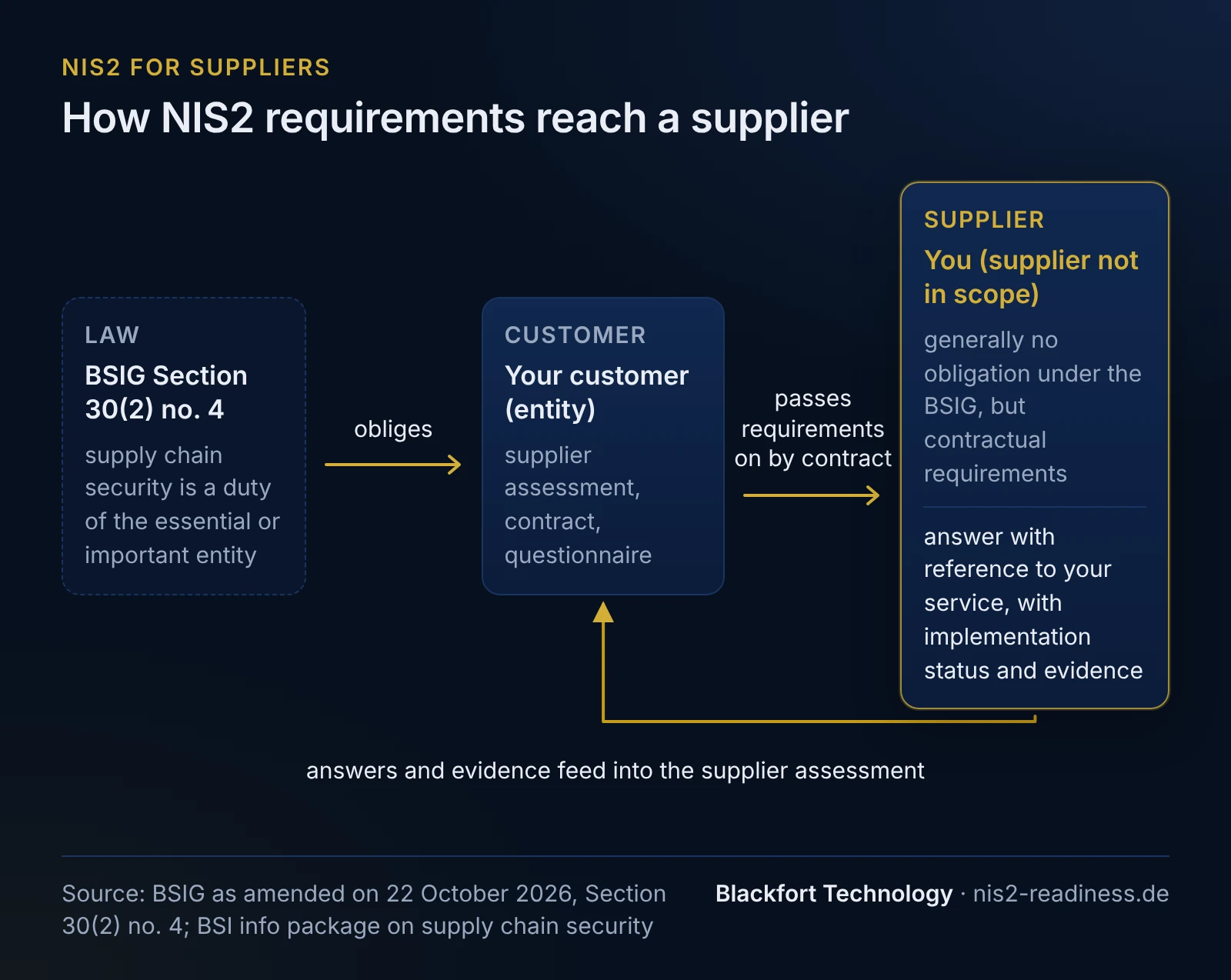
Under Section 30(2) sentence 2 no. 4 BSIG, essential and important entities must take measures for “supply chain security, including security-related aspects of the relationships with direct suppliers or service providers” (our translation). The explanatory memorandum quoted by the BSI (Federal Office for Information Security) gives examples: contractual agreements with suppliers and service providers on risk management measures, on handling cyber security incidents and on patch management, as well as observing principles such as security by design and security by default. The entity should take into account the vulnerabilities of its direct suppliers and the quality of their cyber security practices, including the security of their development processes (as also stated in Article 21(3) of the NIS2 Directive).
The BSI makes clear: the BSIG does not oblige all suppliers and service providers. To meet their own obligations, however, entities must commit their suppliers to corresponding security requirements. For your customer, whether to keep working with a supplier that gives no reliable answers can therefore become a business decision.
For some digital entity types, such as cloud providers, data centre operators and managed service providers, it gets more specific: Implementing Regulation (EU) 2024/2690 requires them to have a supply chain security policy and names contract contents, including the provider’s duty to report without undue delay security incidents that pose a risk to the customer’s systems. If you supply such companies, questions about incident notification are particularly likely.
What can your customer require by contract?
What you owe follows from your contract, not from the BSIG. In negotiations, your customer can ask for almost anything; you decide what you commit to. The table separates where a requirement comes from:
| Requirement | Origin | Assessment for you as a supplier |
|---|---|---|
| Appropriate security measures for the service | customer’s obligation under Section 30(2) no. 4; example in the explanatory memorandum | relate the scope to the systems and data your service touches for the customer |
| Information about security incidents | BSI recommendation; contract content under the Implementing Regulation for the digital entities named there | important for the customer because it has reporting obligations of its own; agree trigger and deadline precisely |
| Patch management | BSI recommendation; example in the explanatory memorandum | mainly for software, devices with software and IT services |
| Security by design and by default, taking BSI recommendations into account | BSI recommendation; example in the explanatory memorandum | mainly for manufacturers of software and connected products; we handle SBOM questions as a service under SBOM service |
| Evidence, information, audits | not prescribed by law; details open | agree type, frequency and confidentiality; the BSI explicitly asks for verifiable properties |
| A specific certificate (such as ISO 27001) | not prescribed by law; according to the BSI there is no general certificate for the supply chain requirement | the customer can ask for it, but a certificate does not replace the customer’s own assessment |
The right-hand column is our own professional assessment. We do not assess liability, contractual penalties, termination rights or indemnities; have such clauses reviewed by a lawyer.
How do you answer a supplier questionnaire?
A questionnaire is answered well when every answer fits the service provided, describes the actual status and is backed by evidence. This is how we approach it:
- Define the scope: which service do you provide for this customer, and which of your systems, data and people does it touch? A parts manufacturer exchanging drawings answers different questions than a service provider with remote access.
- State your own classification first: say that you have checked your applicability under Section 28 BSIG and with what result. That saves follow-up questions.
- Choose a yardstick: the BSI recommends that suppliers who are not in scope check their own compliance with the measures in Section 30(2) BSIG for agreements with their customers. The ten areas of Section 30(2) therefore work well as the structure of your standard answers; an overview is on the page on Section 30 BSIG.
- Be honest about the status: implemented, partly implemented or planned with a date. An answer “planned by March 2027” is more useful to the customer than a “yes” that does not hold up when asked.
- Assign evidence: for every answer, a document, report or log that you can present on request or make available for inspection.
- Approve and maintain: management approves the answers. Keep one master version and adapt it per customer instead of writing every questionnaire from scratch.
There is no standard question catalogue. The BSI welcomes efforts by industry to develop one and, for orientation, refers to the UP KRITIS best-practice recommendations on requirements for suppliers. A questionnaire from the entity’s side to download is on the page on supply chain security.
Which evidence is appropriate?
There is no “NIS2 certificate”, even if the term appears in requests. The BSI states explicitly that there is no general certificate for the supply chain requirement. Appropriate evidence fits the service and the risk for the customer. Suitable evidence examples, from lean to extensive:
| Evidence | What it shows | Limits |
|---|---|---|
| Self-declaration with named supporting documents | implementation status per area, backed by policies, logs and reports | not independently audited; its value depends on honesty and on the supporting documents |
| CyberRisikoCheck under DIN SPEC 27076 | baseline assessment for small and medium-sized enterprises | according to the BSI only an initial assessment; NIS‑2 compliance cannot be achieved with it |
| ISO 27001 certificate | audited management system; according to the BSI covers a large part of the measures under Section 30 if implemented comprehensively | check the scope: does it cover the service for the customer? It does not automatically meet all BSIG requirements |
| Audit report or on-site inspection at the supplier | review by the customer or an appointed auditor | effort for both sides; agree scope and confidentiality |
Our recommendation: offer inspection of confidential documents instead of sending them, for example in a video call or at a meeting. Network diagrams, vulnerability reports and contingency plans do not belong in a questionnaire attachment.
Excessive requirements and how to answer them
Some requirements go beyond what a small supplier can deliver or should commit to at all. The suggested answers below are our professional assessment, not legal advice:
| Requirement | Problem | Suggested answer |
|---|---|---|
| “Provide your NIS2 certificate.” | No such certificate exists. | offer a self-declaration along the ten areas of Section 30(2) and any existing certificates or audit reports |
| “Confirm that you meet all NIS2 requirements.” | You are not an addressee of the BSIG; a blanket commitment can neither be verified nor limited. | limit the commitment to specifically described measures for the agreed service |
| “Report every security incident within 24 hours.” | “Every incident” includes events with no link to the customer; the 24 hours come from the customer’s own reporting duty to the BSI. | commit to informing without undue delay, limit the trigger to incidents that may affect data, systems or delivery capability for the customer, distinguish initial information and follow-up report |
| “Unrestricted on-site audit rights, at any time.” | effort and confidentiality towards other customers not addressed | propose audit rights with advance notice, scope, frequency and priority for document review or remote audit |
| “Bind all your subcontractors in the same way.” | also hits subcontractors with no link to the customer | limit flow-down to subcontractors that have access to the customer’s data or systems or contribute to the service |
Example: a parts manufacturer answers a supplier questionnaire
Fictitious example, not a client. A contract manufacturer of milled parts has 34 employees, €4.8 million turnover and belongs to no group. A machinery manufacturer that has classified itself as an important entity sends it a supplier questionnaire. The contract manufacturer receives drawings via the customer’s supplier portal, sends questions by email and has no access to the customer’s network. An external provider manages its IT. Its answer looks like this (all values fictitious):
| Area | Answer | Evidence | Status |
|---|---|---|---|
| NIS2 status | Applicability under Section 28 BSIG checked: not in scope (34 employees, €4.8 million turnover, no linked enterprises). The following describes our implementation status with reference to our service for you. Binding commitments are governed by our contract. | classification record of 15 September 2026 | implemented |
| Service reference | contract manufacturing to drawing. Customer data: drawings and order data. No access to the customer’s systems. | - | - |
| Responsibility | managing director responsible, contact for information security named, shared mailbox set up | organisation chart, contact details | implemented |
| Handling customer data | drawings in one project folder per customer, accessible only to work preparation and production; deletion twelve months after the order ends | access list, deletion policy | implemented |
| Access and MFA | MFA for email, remote access and administrator accounts; other accounts to follow | report of the sign-in configuration | partly, complete by 31 March 2027 |
| Updates | security updates for servers and workstations monthly, critical vulnerabilities out of cycle; machine control computers after manufacturer approval | patch report of the IT provider | implemented |
| Backup | daily backup, one copy kept offline, restore test once a year | log of the last restore test of 12 August 2026 | implemented |
| Incidents | customer informed without undue delay, at the latest 24 hours after becoming aware, if drawings or order data may be affected or delivery capability is at risk; follow-up report once clarified | security incident procedure | implemented |
| Training | annual briefing for all staff with a computer workstation, focus on phishing | attendance list | implemented |
| Service providers | IT provider contractually bound to confidentiality, updates and incident notification | contract extract for inspection | implemented |
| Certificates | no ISO 27001 certificate; CyberRisikoCheck under DIN SPEC 27076 carried out in May 2026 as an initial assessment | result report for inspection | - |
| Evidence | inspection of all documents listed by appointment; confidential documents sent only under a non-disclosure agreement | - | - |
It comes with a short cover note that the contract manufacturer uses for all customers:
“We have checked our applicability under Section 28 BSIG and are neither an essential nor an important entity. We know that, as an in-scope entity, you must ensure the security of your supply chain, and we answer your questionnaire with reference to our service for you. Where a measure is not yet fully implemented, we give the date. We are happy to show you the evidence listed in a joint meeting.”
The answer commits only to what the company can prove and makes gaps visible with a date. It deliberately contains no commitments on liability or contractual penalties; those belong in the contract negotiation.
Three typical gaps on the supplier side
| Gap | Cause | Effect | Remedy |
|---|---|---|---|
| Every questionnaire answered from scratch | no standard answers, changing responsibility | contradictory statements to different customers, high effort | one approved master version along the ten areas of Section 30(2), updated annually and after changes |
| Commitments without evidence | questionnaire answered “yes” under time pressure | evidence is missing when asked or audited, the customer’s trust suffers | name evidence for every answer; without evidence, state “partly” or “planned” |
| Incident information not prepared | commitment in the contract, but no procedure and no contact list | the customer learns of an incident too late for its own reporting duty | procedure with triggers, contacts per customer and a template for the initial information; rehearse once a year |
How we help
We help suppliers build a reliable master answer, prepare the matching evidence and assess technical and organisational requirements from customers. Have the contract clauses themselves reviewed by a lawyer. If the check shows that you are in scope yourself, the NIS2 gap analysis shows where you stand.
Frequently asked questions
Do we have to register with the BSI as a supplier?+
Do we have to answer our customer’s questionnaire?+
Is an ISO 27001 certificate sufficient evidence?+
How do we deal with several different questionnaires?+
Do we have to send the customer our entire security concept?+
Read more
Sources
- BSI Act (BSIG), consolidated version, last amended 22 October 2026, Sections 28, 30, 33 (German) (retrieved 2026-11-06)
- BSI: #nis2know supply chain security info package (German) (retrieved 2026-11-06)
- BSI: general NIS‑2 FAQ (scope no. 27, obligations no. 10, supply chains nos. 1 and 2), in German (retrieved 2026-11-06)
- BSI: one-pager NIS‑2 and ISO 27001, version 1.0 of 1 April 2026 (German) (retrieved 2026-11-06)
- Commission Implementing Regulation (EU) 2024/2690, Annex no. 5 (supply chain security) (retrieved 2026-11-06)
This content provides general technical and organisational information and does not constitute legal advice (no legal services within the meaning of the German RDG).