

Last updated: 2026-11-22
With proposal COM(2026) 13, the Commission wants to amend the NIS2 Directive (EU) 2022/2555 in several places. It is part of a package with the proposal for a new Cybersecurity Act ("Cybersecurity Act 2") and, according to the Commission's explanatory memorandum, is meant to simplify compliance, increase legal certainty and align implementation across Member States. It should not be confused with the "Digital Omnibus" COM(2025) 837 of 19 November 2025: that separate proposal amends several digital laws, including the NIS2 Directive, and is mainly meant to bundle incident reporting into a single reporting channel. This page summarises what the proposal contains, where the procedure stands and what it means for entities in Germany today. What counts is the text of the proposal. Every point can still change in the legislative procedure.
Where does the procedure stand?
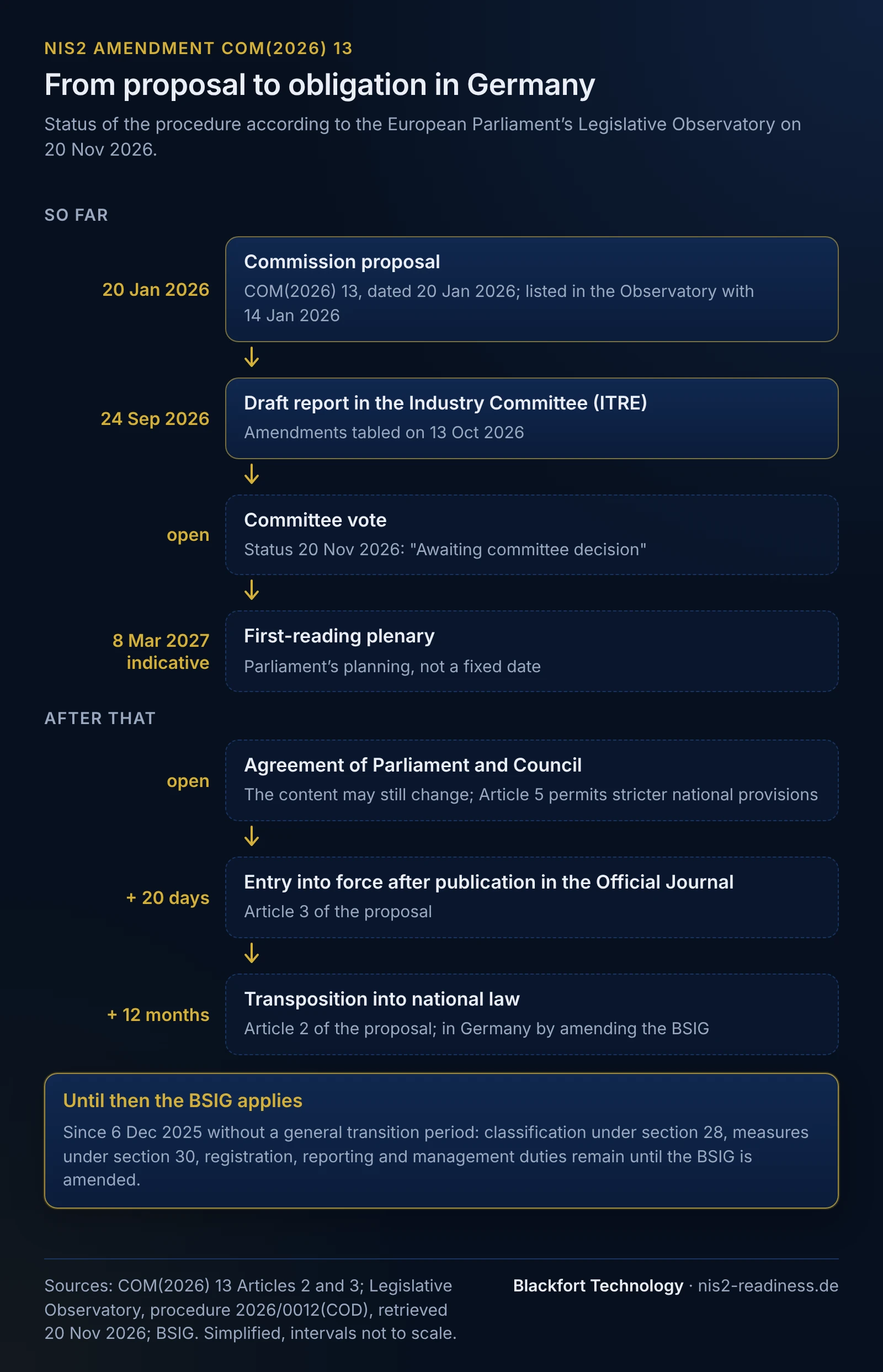
The proposal follows the ordinary legislative procedure under reference 2026/0012(COD). Parliament and Council both have to agree. Status according to the European Parliament's Legislative Observatory on 22 November 2026:
| Date | Step |
|---|---|
| 20 Jan 2026 | Commission proposal COM(2026) 13, dated 20 Jan 2026 (the Legislative Observatory gives 14 Jan 2026 as publication date) |
| 25 Mar 2026 | Referral to the lead Committee on Industry, Research and Energy (ITRE) announced in plenary |
| 24 Sep 2026 | Draft report in ITRE |
| 13 Oct 2026 | Amendments tabled in committee |
| 16 Nov 2026 | Opinion of the Internal Market Committee (IMCO) for the lead committee ITRE |
| open | Committee vote, status "Awaiting committee decision" |
| 8 Mar 2027 | Indicative date for the first-reading plenary (Parliament's planning, not a fixed date) |
No Council position is recorded there so far. Once Parliament and Council agree, the amending directive enters into force 20 days after publication in the Official Journal. Under the proposal, Member States would then have twelve months to transpose it into national law (Articles 2 and 3 of the proposal). For entities in Germany, nothing changes until the German legislator amends the BSI Act (BSIG).
What the proposal would change
The following points are in the articles or the annex of the proposal. References are to the amended Directive as proposed.
Small mid-caps are as a rule to become important entities
The Directive is to adopt the category of small mid-cap enterprises from Recommendation (EU) 2025/1099 (Article 6(42)). These are enterprises that are no longer SMEs, employ fewer than 750 persons and have an annual turnover not exceeding EUR 150 million or an annual balance sheet total not exceeding EUR 129 million. Partner and linked enterprises count towards the calculation. For entities of the Annex I sectors, the size threshold for being classed as an essential entity is to move from the ceilings for medium-sized enterprises to the ceilings for small mid-caps (Article 3(1)(a)). According to recital 2, small mid-caps from Annex I should as a main rule be designated as important entities. Classification on other grounds, such as critical entities, is unaffected. The German language version says "Midcap-Unternehmen" at this point, the English one "small mid-cap enterprises". We follow the English version because recital 2 and Article 6(42) refer expressly to small mid-caps.
For comparison, current German law: under section 28(1) no. 4 BSIG an entity of a type listed in Annex 1 is already an "especially important entity" from 250 employees, or from an annual turnover above EUR 50 million together with a balance sheet total above EUR 43 million. "Besonders wichtige Einrichtung" is the German term for the Directive's essential entity. An entity that falls into this group today on size alone but stays below the mid-cap ceilings would likely become an important entity once the BSIG is amended accordingly. Operators of critical facilities remain especially important entities regardless of size under section 28(1) no. 1. The measures under section 30 BSIG apply equally to both categories, implemented in a risk-based and proportionate way. Certain telecommunications and energy entities fall under the exceptions in section 28(5). The differences lie mainly in supervision and the range of fines.
A certificate as evidence
Member States are to be able to require entities to demonstrate compliance with Article 21 through a cyber posture certificate under a European certification scheme (Article 24(4)). Where such a certificate shows that the requirements are met, authorities are not to impose additional security audits under Article 32(2)(b) or Article 33(2)(b) for the requirements covered (Article 24(5)). The entity remains responsible for compliance (Article 24(6)). No such certification scheme exists yet. It is to be created on the basis of the planned Cybersecurity Act 2.
More uniform requirements, fewer national additions
The Commission is to be able to adopt implementing acts with technical, methodological and sectoral requirements for the risk-management measures of further types of entities (Article 21(5), second subparagraph). Where such acts apply, Member States may not impose further requirements on those measures for the entities covered (Article 21(5), fifth subparagraph, and Article 5). So far there is one such act, for certain digital services: Implementing Regulation (EU) 2024/2690.
Ransomware information
The Commission is to require, in the implementing act under Article 23(11), that reports state whether a ransomware attack occurred, its attack vector and whether remediation measures were implemented (Article 23(12)). At the request of the CSIRT or the competent authority, they are also to state, for a significant incident caused by ransomware, whether they received a ransom demand and whether they paid, how much and to whom (Article 23(13)).
Scope and registry
- Out: DNS service providers that are micro or small enterprises (Article 2(2)(a)(iii), Article 3(1)(b), recital 2; in Germany only once section 28(1) no. 2 BSIG is amended), and electricity producers with a total generation capacity of no more than 1 MW (Annex I point 1(a)).
- Clarified: healthcare providers, hydrogen undertakings and, in Annex II, the chemical industry, which is tied to the registration obligation under Article 6 REACH and the notification obligation under Article 7(2) REACH and thus partly redefined.
- New: providers of European digital identity wallets and European business wallets regardless of size, operators of submarine data transmission infrastructure, where not already covered as another type of entity, and, regardless of size, owners, managers and operators of strategic dual-use infrastructure (Article 2(2) and (3a), Annex I point 8).
- Registry: IP address ranges and notification of changes within two weeks are already in the current Directive (Article 3(4)), and in the BSIG in section 33(1) and (5) (changes without delay, at the latest two weeks after becoming aware). The proposal adds the type of entity, other establishments and the representative in the Union, a unique identifier and, where applicable, the address of the European business wallet (Article 3(4)). ENISA is to keep a registry of all essential and important entities and support the supervision of entities operating across borders (Article 27(1), Article 37a).
In addition, Member States are to set out policies for the transition to post-quantum cryptography in their national cybersecurity strategy (Article 7(2)(k)). Commission guidelines on supplier requests are announced only in recital 9 and the explanatory memorandum, not in the articles. The proposal contains no new obligation for suppliers and no limit on questionnaires.
What applies until then
The BSIG has applied since 6 December 2025 without a general transition period and was last amended by an act of 22 October 2026. Section 66 only defers individual rules on critical facilities. Registration (deadline under section 33), risk-management measures under section 30, reporting obligations and the duties of management apply regardless of the proposal. This EU proposal alone does not change any existing classification. The legal status is explained on the page NIS2 Implementation Act, classification on the page NIS2 applicability. If you cannot fill the role for ongoing implementation internally, Blackfort offers an external information security officer.
Example: classification of a fictitious company
A district heating supplier (Annex 1, energy sector) with 420 employees, EUR 95 million annual turnover and a EUR 110 million balance sheet total, not an operator of a critical facility. The figures are invented, the classification is simplified and does not replace a case-by-case assessment.
| Question | Today (BSIG) | Under the proposal, once transposed |
|---|---|---|
| Category | especially important entity, because it has at least 250 employees (section 28(1) no. 4) | small mid-cap (not an SME, fewer than 750 employees, turnover not exceeding EUR 150 million or balance sheet total not exceeding EUR 129 million), therefore as a rule an important entity, provided the BSIG is amended accordingly (Article 5 permits stricter national provisions, except where implementing acts apply) |
| Measures under section 30 | to be implemented in full | still to be implemented |
| Registration and reporting | mandatory | mandatory; the BSIG already requires IP address ranges and notification of changes within two weeks today (section 33). New would be the ransomware information: in the report under the future implementing act (Article 23(12)), ransom details only on request (Article 23(13)) |
| What to do now | keep implementing and documenting the measures, follow the procedure, re-check the classification once the BSIG has been amended | |
Three misconceptions
| Misconception | What is correct | Reference |
|---|---|---|
| "The EU is weakening NIS2, so we will wait before implementing." | The proposal has not yet been adopted, and until an amendment the BSIG applies with all its obligations. Article 21(2) remains unchanged under the proposal. The Commission could, however, specify the measures further through implementing acts. | BSIG sections 28, 30; Article 2 and Article 21(5) as proposed |
| "With a certificate we are rid of the NIS2 obligations." | A certificate is only meant to make additional security audits unnecessary for the requirements it covers. Responsibility stays with the entity, and a suitable European certification scheme does not exist yet. | Article 24(4) to (6) as proposed |
| "Suppliers no longer have to answer NIS2 questionnaires." | The proposal only announces Commission guidelines on the scope and format of such requests. Entities remain obliged to secure their supply chain. | Recital 9 and explanatory memorandum section 5; Article 21(2)(d) of the Directive |
How to deal with your customers' requirements as a supplier is covered on the page NIS2 for suppliers. More on the supply chain is on the page supply chain.
This page is general information on the status of the legislative procedure and not legal advice on an individual case.
Frequently asked questions
Has the amendment to the NIS2 Directive been adopted?+
Does the BSIG continue to apply unchanged in Germany until then?+
What is a small mid-cap enterprise?+
Do important entities lose obligations under the proposal?+
Read more
Sources
- European Commission: proposal COM(2026) 13 final amending Directive (EU) 2022/2555 of 20 January 2026 (retrieved 2026-11-20)
- European Parliament, Legislative Observatory: procedure 2026/0012(COD) (retrieved 2026-11-22)
- European Commission: proposal COM(2025) 837 final (Digital Omnibus Regulation) of 19 November 2025 (retrieved 2026-11-22)
- Commission Recommendation (EU) 2025/1099 on the definition of small mid-cap enterprises (retrieved 2026-11-20)
- BSI Act (BSIG), section 28 (German) (retrieved 2026-11-20)
- BSI Act (BSIG), section 30 (German) (retrieved 2026-11-20)
- BSI Act (BSIG), section 33 (German) (retrieved 2026-11-20)
- BSI Act (BSIG), section 65 (German) (retrieved 2026-11-20)
- Directive (EU) 2022/2555 (NIS2 Directive), EUR-Lex (retrieved 2026-11-20)
This content provides general technical and organisational information and does not constitute legal advice (no legal services within the meaning of the German RDG).